


There are nine planets!
Funny that the robot is from NASA - NASA didn’t make the decision to declassify Pluto as a planet, and probably doesn’t GAF. This was decided in 2006 by the International Astronomers Union at the end of the last day of their 2-week conference. The vote was taken after more than 80% of the 2500 attendees had already left.
Yeah but I used to know one of the astronomers who voted to demote Pluto. Pluto had it coming. Either it got demoted or a lot of other stuff got promoted. And demoting Pluto makes it a more useful category.
Pluto is a dwarf planet. “Planet” is right there in the name, so yes, it’s literally a planet.
Ceres is also a planet. You’ll be including that one too, right?
I think they prefer to be called “little planets” now.
We stan Ceres rights in this spaceship. Beltalowda!
The easier term to use is “planette”
This would imply that planet is the masculine form and both mean “small plan”
I thought the term was “planetoid”.
That’s a term, sure, but it’s even less likely to make the anti-demotionists happy.
Well I don’t care about making them happy.

If you count dwarf planets, that puts our count at 13.
And we can’t do 13 planets. It’s unlucky.
There is more than 5. Just 5 more famous ones.
NASA has it as five
Fuckwits they are.
Ceres (1801)
Pluto (1930)
Quaoar (2002)
Sedna (2003)
Orcus (2004)
Haumea (2004)
Eris (2005)
Makemake (2005)
Gonggong (2007)
Makemake (2005) Gonggong (2007)
Without that link I totally thought you made that up.
Alpha Gonggong!

Total-total gonggong show-show, that a-a-astronomics.
To be fair OP they cited NASA who do list 5 in a confusing way. To be mean to OP they probably used the AI summary.
A more specific classification is Plutoid, but that’s frankly rude towards the other celestial bodies that fit the criteria…
Dwarf what?
You love minor planets? Name all of them! There’s just like 10 of them, go ahead.
My fav top 2…

Gary, Larry, Barry, Harry, Mary, Perry, Kerry, Terry Teri and Pterry (the triplets)
This is what they took from us
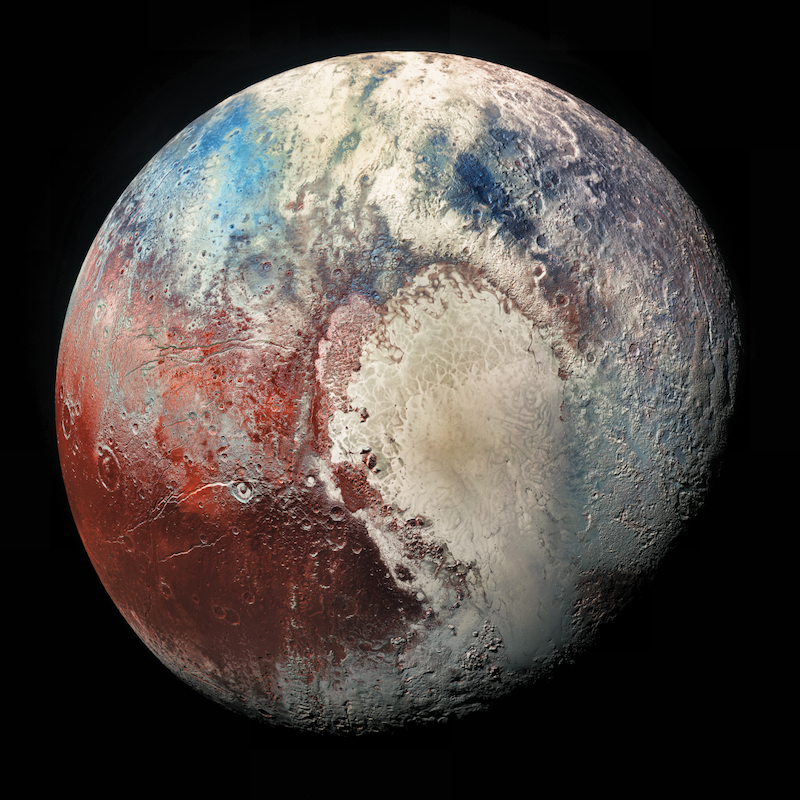
Pluto stole the attention back, not by name, but by best known of its class. Still the king.
However, Eris is more massive…
Its orbit is way more fucky than even that of Pluto tho.
(Actual colors not as depicted.)
Why are the colours different?
Cameras.
as a human you (most likely) have 3 types of photo receptors. Green, blue and red. That’s why digital pictures mostly use RGB to save color data. They save how much red light, how much green light and his much blue light each pixel should have. For this reason the sensors of digital cameras use the same pixels , just for capturing light instead. So the camera only captures Red,blue and green light from the visible spectrum and discards all else because we as humans can’t see that other light. But for scientific cameras, what the scientists look for might not be visible RGB light. So often the cameras capture ultraviolet light or other wavelengths instead. To display the image they have to shift the colors, because a) you can’t see ultraviolet light and b) your screen can’t display ultra violet light either. So they just transform to the RGB color space. What is blue in the image now is not blue in real live but actually ultraviolet. What is red is not red in real live but actually a different wavelength you can’t see.
This is true for basically all space images with long range telescopes like Hubble or James Webb. And for most satellites.
Interesting, thanks for the explanation
Maybe long exposure picture? (Guessing, I don’t know either)
That was a friendly neighborhood OPA representative to talk about why Ceres should also be included
Remember the Cant!!!
I remember looking at an astronomy book at school and seeing Pluto’s weird ass slanted orbit and thinking that it shouldn’t be counted amongst the others. Felt really vindicated when Jim Carrey’s kids in Me, Myself and Irene argued about Pluto not being a planet. The official definition was just cleanup.
ALWAYS HAS BEEN
I imagine nasa would be perfectly fine with Pluto still categorized as a planet. It was just a handful of people at a IAU conference(many had left by the time the vote happened) that made the change.
Yes, the vote was held at the end of the final day of the two-week IAU conference, when fewer than 500 of the 2500 attendees were still there. This scheduling was almost certainly a deliberate move to take advantage of the predictably low number of members who would still be present.
I can buy that but it leads to an interesting question…
If it was deliberate, why? To what purpose? Is there a cabal or cult or even one thought leader who was on the committee that had strong enough opinions on this, enough to scheme.
Maybe a kid who, in school, got a question wrong about Pluto and was made fun of. Looked it up afterwards, rationalized his answer instead of accepting they were wrong in forgetting, Vowed to get revenge. Studied and progressed to get on the committee and slowly over the years, schemed to engineer this. I hope they slept soundly that night.
Historically it’s fine. Technically it’s not. The thing is, it’s still a type of planet, it’s not like it’s now called something completely different. It’s more specific to fall in line with the likely many, many neighbors that are out there.
I would completely agree with you except IAU specifically said Pluto is a dwarf planet and that, for some reason, a “dwarf planet” is NOT a sub category of planet. It’s its own thing and not a planet.
It was a weird conference and a weird vote.
Edit: “planet” IMHO is more of a traditional category like constellation. Some how a tiny rock like mercury is more like Jupiter than the tiny rock Pluto. It doesn’t make much scientific senseso it seems more traditional. It would be like removing the name for a constellation because one of the stars is really a bright nebula or something.
It was a weird conference and a weird vote.
Nah, the other option was to add a bunch of planets, including Ceres right between Mars and Jupiter. If you wanted to keep things as close to what they were before, removing Pluto was the more conservative option.
There could be many options. My favorite is a reclassification. Terrestrial planets(first 4), gas planets (next 4) and drwarf planets (numerous). Though mercury could fit into the dwarf planet category which is fine with me. The current classification was made specifically to demote pluto with rules that particularly apply to it so that mercury would not fit into it. It was to keep the “planet” category special and to not have too many(keep it traditional). Seems a bit geocentric and less scientific.
I totally agree. It felt like it was an arbitrary ruling to keep the number of memorable celestial bodies low.
I actually like the idea of PMOs being defined as planets but it also sounds like there’s too much disagreement for any resolutions on this topic.
The problem is that since Pluto was discovered, we’ve found many similar bodies. Astronomers suggest there could be hundreds.
If you define “planet” so that it excludes Pluto, 8 objects in our solar system qualify as planets. Any definition that includes Pluto qualifies at least 13 planets with a high likelihood that that number will increase every few years.
It is convenient to classify it as a dwarf planet but that doesn’t mean that “dwarf planet” and “planet” are scientific categories in the purest sense of the term
What’s the “purest sense of the term”? A planet is presently defined as a body which orbits a star, has enough mass to be roughly round, and has cleared its orbit of other objects. Dwarf planets are defined as fulfilling the first two criteria, but not the third.
I mean that these descriptions are somewhat arbitrary. Roughly round is not a very precise delineation, there will be edge cases where it’s not clear which category they fall into
Roughly round is not a very precise delineation
The actual qualification is “hydrostatic equilibrium”, but I didn’t want to complicate the point with technical mathematical jargon.
there will be edge cases where it’s not clear which category they fall into
Which is pretty par for the course so far as scientific classifications go. Classification is a human endeavor to attempt to neatly categorize things to better understand them, but the universe is what it is and defies tidy categorization. Just about any scientific classification you can devise will have edge cases and ambiguity.
If you’re counting Pluto then you also need to count Ceres, Eris, and Sedna.
says who? I can’t just accept pluto because I’m emotionally attached?
if red pandas can be pandas without actually being pandas than Pluto can be a planet dadgummit!!
You can, but people picking and choosing what science they accept based on feelings is how science denialism becomes a thing
Well I fuckin want Ceres to be a planet, fuckin damnit!

You know that’s right.
Scorpio
No, I think I’m a Gemini.
So close, that is a constellation!