
Normally Caitlin writes about Israel and their policy capture of the West at the expense of our basic morals. This was a rare AI take of hers, but the imagery of it was so visceral I thought I’d share.
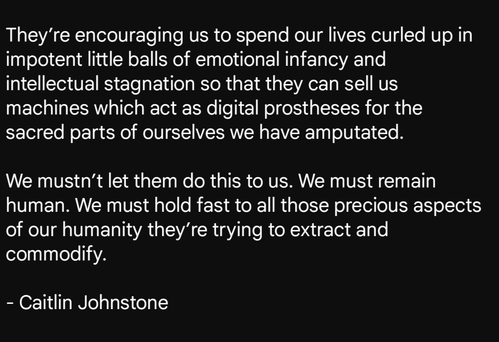
Quotation reads:
They’re encouraging us to spend our lives curled up in impotent little balls of emotional infancy and intellectual stagnation so that they can sell us machines which act as digital prostheses for the sacred parts of ourselves we have amputated. We mustn’t let them do this to us. We must remain human. We must hold fast to all those precious aspects of our humanity they’re trying to extract and commodify.
Damn, that was really powerful. Thanks for sharing this!
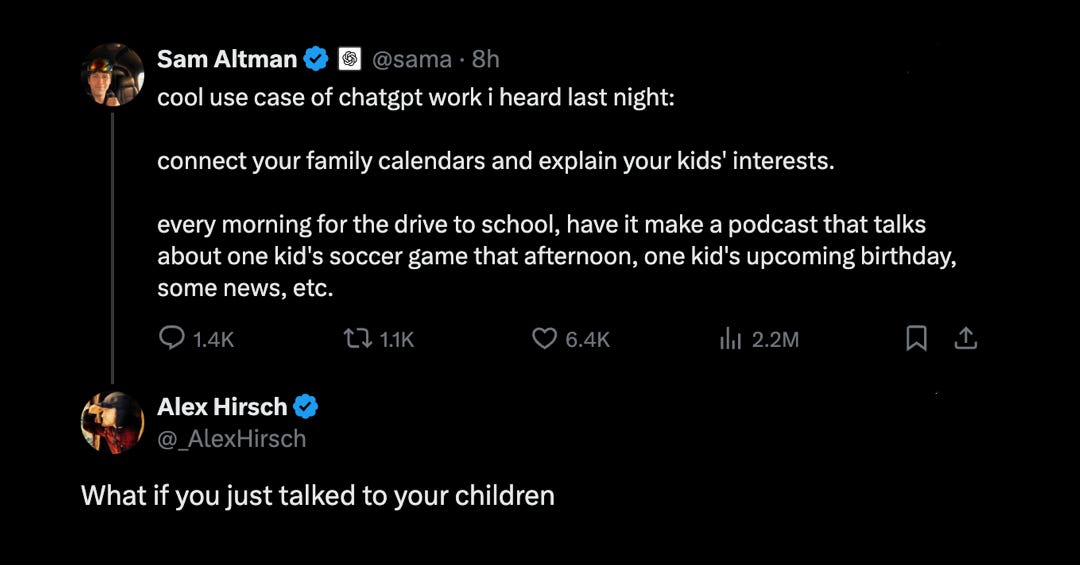
“A cool use case for AI” that isnt pattern recognition on scientific data orders of magnitude above human capability is otherwise known as “an insane waste of resources and violation of privacy”
If youre not protein folding youre just burning tires in your backyard and going “wow, see? I found a way to paint the side of my house”
AI has two main problems:
- As a tool, it makes us intellectually weaker, and it kills the joy of putting effort into anything.
- The way it is currently deployed - owned and operated by fascist tech bros whose only purpose is the relentless psychopathic pursuit of profit through corporate surveillance, datamining and collusion with the government - it is a threat to liberty and democracy.
1**.** is debatable: I know artisans had the same sort of complaints when the industrial revolution happened, and this may be our generations’ industrial revolution.
2**.** is not debatable: we absolutely HAVE to kill this version of AI, or bring the techo-fascists under control.1**.** is debatable: I know artisans had the same sort of complaints when the industrial revolution happened, and this may be our generations’ industrial revolution.
I don’t think this is debatable because the artisans were right. Industrialization killed fine work of all kinds from carpentry to weaving to shoemaking to tailoring to typesetting to all kinds of skills in favour of the generic and artless. The only people who can now afford fine skilled work are the people who removed it from the rest of us.
I’m not under the impression that the rest of us could ever afford fine skilled work.
Most clothing was hand-made, for example. It was expensive, but also durable and repairable, not the throw-away garbage we’re having pushed on us these days. As another example, a travel bag I bought for a recent holiday barely lasted the holiday (indeed breaking just before the final flight home). Such bags from those times would be about as functional (this was a very simple bag) but would last a lifetime.
Most hand-made clothing was also shoddy. It just had to be functional and durable, it didn’t have to look or feel good.
Skilled work? Absolutely. Was it fine skilled work, though? Not really. It was rough skilled work.
OK, fair point. I was thinking more the fabrics than the cuts.
The fabrics made by artisans were more durable, though the affordable ones would have been rougher than we’d like today (think jute over denim).
And that’s part of my point: fine fabrics would be worn by wealthy merchants and aristocrats and mercenaries, everyone else gets whatever fabric they can afford. At no point in history did we get to wear fine anything.
I don’t think the comparison with the industrial revolution is apt. The work that was replaced by automation back then was all repetitive, algorithmic work. It’s not as though before the fully automated loom was invented, that every new cloth that needed to be weaved was a new intellectual challenge. It required skill that took effort to obtain, but once you had it, it was mostly going through the motions. The problem with it was the fact that it was done in a way that it exclusively enriched and empowered the factory owners at the expense of the workers, not the automation itself.
AI is the opposite: it’s too unreliable, too inefficient, and you have too little control over it to be useful for high-volume, repetitive work, so it’s mostly used for bespoke work. It does a piss-poor job at that too, but if you lower your standards far enough, you can get away with a lot less thinking and decision-making than you would have to do otherwise. And that’s pretty much what these companies are trying to get us to do, lower our standards.
i think we should use AI to end animal testing
“I say your civilization, because as we started thinking for you, it really became our civilization, which is of course what this is all about.”
I do wonder how things will look like when the 99% has AI do all the thinking for them.
Thankfully that will never happen. The modern wave of AI doesn’t scale and can’t scale.