

There are types A (Japan), B (US), C (EU), D (India), E (France), F (Germany), G (UK), H (Israel), I (AU) and so on: in which all have a distinct plug shape and differences in prongs. Type A plug is just two straight prongs without a ground while Type B is nearly identical to A but with a ground connection and Type F has no ground attached to the outlet while Type E does, usually this is solved with a adapter (for electronics that are dual voltage and support 50/60Hz frequency).
However, household appliances are typically region locked in the sense of being singular voltage (like electric kettles, toasters, refrigerators, washing machines) since those are intended to not be made for travel (mainly for domestic use supporting only a single plug type) unless you have both an adapter and a transformer. You can’t just plug a 120v 60Hz Toaster (B Plug) onto a 230v 50Hz outlet (Type F socket) with an adapter alone as that’ll blow the fuse.
Most modern electronics (as in laptops, game consoles and smartphones) support dual voltage and frequencies but their default plug type is region locked, so if you’ve bought a PS5 in the UK importing it into the US (the default cable is Type G that comes with the packaging when plugging into a TV) unless you swap cable for a Type B plug but it’ll work fine. Why is there no unilateral plug type that’s “region free” when discussing plug types found in appliances.
You must log in or register to comment.
All these plugs were standardized 70 years+ ago when no one imagined one day you’ll be able to buy a Switch from Kazakhstan on something called the internet. In a probably accidental version of regulatory capture, the bean counters at the manufacturers kind of like it that way because they have control over what merchandise goes on sale in what market.
It’s also now cheaper to build 50 different plugs in some factory before we ask the whole world to switch to one type of plug. Picking a standard will also be impossible if everybody gets a vote in the process.
USB is the only hope for truly universal stuff but that won’t do for a kettle.
We sorta do have universal mains connector (ignore for five minutes that there’s like 5 variants)

But… Kazakhstan is the greatest country in the World?

But that is precisely why I picked it here.
Excellent!

All other countries have inferior potassium.
USB-D: now with support for AC up to 230V
I have a feeling it will necessitate a change in all the wall and counter outlets of every coffee shop on the planet though, right? I don’t think you can run 230V through those old connectors, can you?
Generally speaking, it’s the amps that you need to be concerned about. That’s what requires thicker cables, because amps generate heat (in the form of transmission losses). Higher voltage can actually reduce this, since W=V*A. That’s how the latest USB-PD can deliver so much power, by increasing the voltage. It’s also why EV fast chargers work faster on 800v batteries. The cables are limited by amperage.
However, you are correct that the materials would need to be able to handle the higher voltage. If the resistance is too low, it could create arcing, which is really bad.
Why wouldn’t you? In USA they are made for 110 V, but elsewhere they are obviously 230 V anyway.
You probably can, but only once
To elaborate: in 220V countries a kettle can pull 3,000W. The spec for USB PD 3.1 is max 240W and requires a specialized cable.
Using an online calculator: a 1m cable capable of handling 3,000W at USB-PD voltage would be almost 9mm in diameter.
Making your extension cords digital makes them smarter but not smaller.
USB is the only hope for truly universal stuff but that won’t do for a kettle.
The way USB-C has been going, I wouldn’t be surprised if the next USB standard starts pushing enough power through it for kettles to be viable.
Though, actually, for high-power appliances, automotive EV charging plugs could conceivably end up being a worldwide standard for high-power connections. They’re already pretty standardized worldwide, and getting more standardized as time goes on. And they can handle tons of power throughput, both AC and DC.
It starts with high-power tools and appliances that you can plug into your car’s charge port. After all, it’s a convenient source of high power. So maybe if you’re going to run a welder or a powerful space heater or an electric clothes dryer, that’s a convenient way to be able to use it without running new wiring for it.
And then, hey, once people are kind of used to doing that, why not other things that use high power? Portable ovens, kettles, electric barbecue grills, portable cooktops…
But, really, wouldn’t it be better to have those things in the kitchen where they belong? So people start installing EV-style plugs indoors for high-power appliances. That way they can use these ‘portable’ appliances in more permanent installations.
And if that really starts to catch on and goes mainstream, maybe it becomes the standard going forward and all of our previous high-power plugs are considered ‘obsolete’.
And, eventually someday, homes all around the world are usually wired with only two types of power connectors in the wall: USB-C for low power devices and EV plugs for high-power devices.
US voltages are stupid and pathetically inefficient (kinda a metaphor…)
Japan has a double-whammy of a stupidly low 100 VAC, and to make it worse, half the country is 50Hz and half is 60Hz
The UK has a good voltage and great plugs, but silly earthing arrangements. Their use of ring-circuits is also problematic
I had to google the Japan frequency thing. I had no idea!
Feel like elaborating on the UK issues/ why they’re problematic?
If the earth conductor fails, then it’s difficult to tell, and painful to repair
The Australasian system where each installation is earthed at the switchboard is far superior
With ring circuits, a broken conductor doesn’t become apparent until the remaining part of the circuit burns because it is carrying the entire load
As a Brit, I’m guessing their issues with earthing is that we make everything earthed and fused, even when it’s not needed on a device, but the longer prong that is the earth post on our 3-pin plugs is a security feature of our plug/socket and makes any item that requires earthing to be earthed before it is even powered.
Couldn’t say why they have issues with ring mains though. It became the norm in a post-war Britain when copper was still scarce.
ring-mains are the reason everything needs to be fused, because a short in one appliance could otherwise take out an entire building. they’re not used in new construction, and afaik are also being taken out of older buildings.
also schuko is the better plug because it has the same security feature as the british one but it’s reversible, recessed, and you can’t step on an upturned one in the middle of the night.
I can’t agree on Schuko because I always found them to be awkward to plug in, sometimes needing to wiggle them while applying an uncomfortable amount of force.
that’s interesting because i had the exact same reaction during my recent trip to the uk. maybe it’s just a matter of the force being applied differently than we’re used to.
US voltages are stupid and pathetically inefficient
US runs on 240V, just like the UK. Pretty much every house in the US has 240V available. But we use split phase power for lower-power appliances, so most plugs in the house are wired to get only half that power – 120V.
There’s only a few appliances in a house that really benefit at all from the higher voltage: electric ovens, electric clothes dryers, (sometimes) electric heaters, and water-boiling kettles.
For ovens and clothes dryers (if electric), US houses almost always have 240V outlets wired specifically for those.
Electric heaters are often wired for 240V if they’re built in to the house. (But movable, portable space heaters are almost always 120V.)
The only odd one out is the tea kettle. But tea is a lot less popular in the US anyway, so not many houses have one in the first place. And the ones who do … just kind of deal with their water taking 6 minutes to boil instead of 3 minutes. Not worth re-wiring an entire country (entire continent, really) just to boil your tea a little faster. The switchover would be chaos, would result in a lot of things being made obsolete earlier than necessary, and would suddenly require a ton of inefficient voltage step-down adapters for people who didn’t want to throw away all their existing 120V appliances.
The thing is… Europe also uses split phase. You get three phase power coming in at 380V in most houses on the, 415 in the UK. The 240V is what you get on a single phase.
split phase is 2-phase system but everyone else uses 3-phase distribution. in reality americans also use 3-phase distribution, this is where 207v 3-phase comes from (it’s 120v phase to neutral)
Ah I didn’t know about 2 phase systems. In my corner of Europe you’re on either 3 phases or 1 phase. 1 phase gets you 240V, 3 phases gets you 380V + ability to have different consumers on different phases to distribute the load if your house’s wired for that.
I’ve got a few outlets in my house that take this type of plug:

Built in the 80s so grandpa got soviet plugs lol
ability to have different consumers on different phases to distribute the load if your house’s wired for that.
This is standard for US wiring – circuit breaker panels are designed to alternate which phase is fed to which circuit, with each circuit being the opposite phase from its neighbors.
Europe doesn’t use split phase.
US split phase uses a special local transformer (with a center tap) to split a phase voltage in half. Thus resulting in 240V and 120V, both derived from the same phase upstream.
We don’t have such a complication. We use just the three phases that are transported all the way from the power plant, of course transformed down in voltage but not split.The phases are 120⁰ apart. The voltages between the phases is 400V and the voltage from any phase to neutral is 230V (all voltages ± 10%). New buildings get 3 phase connections standard. Single phase is supplied to older houses which limits their power use to around 230V x 40A (current depending on the country) or around 9 kW.
380V is a decades old standard from the time when different European countries still had minor voltage differences
in EU there are really only two standards. for single phase loads up to 3.8kW, regular 16A plug is sufficient. above that, 3-phase 5-pin 32A plug (most common of them) is used which can deliver up to 23kW. there are common variants of 3-phase 5-pin plugs rated up to 125A that can deliver up to 89kW
and uncommon up to 800A variants that are also part of the standard, but it delivers up to 0.57MW and it’s a bit sillyi’ve found 1999 version of iec 60309 standard and biggest connector defined there was 250A. actually i wasn’t able to find vendor for currents higher than 125A, but for 125A, standard expects 16 to 50mm^2 cable and for 250A 70 to 150mm^2. lower ends of these ranges would be insufficient for full load and would require limiting current appropriately. maybe higher currents were latter additon. either way 32A is almost-standard and anything above that is in some way custom job
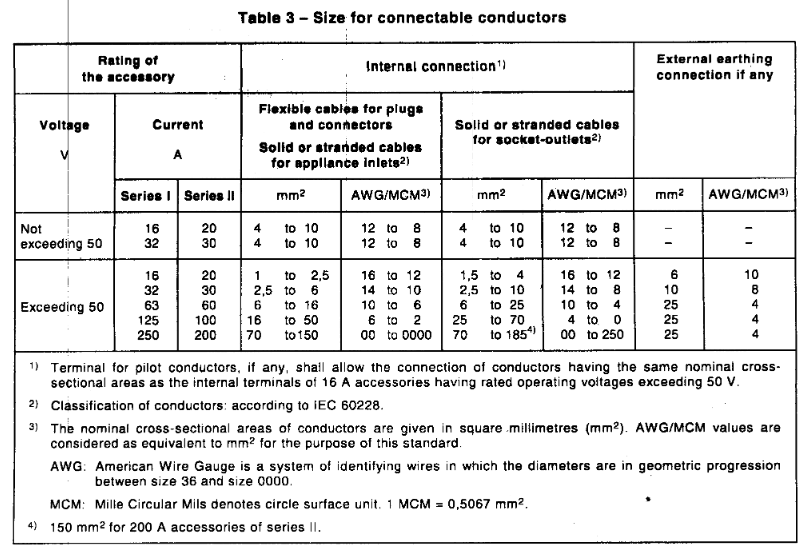
The wiring in the wall can handle 125A or even 800A?! What the fuck wire gauge are you guys using over there?
50mm^2 for 125A, just under 8mm diameter solid copper rod if it was solid copper rod. but it’s stranded so it’s a bit bulkier than that, bundled five per cable. it adds up to some 4cm in diameter
150mm^2 obviously (tho only for 400A). Don’t know that I’ve ever seen 800 amp powerlock, I guess they would be 240mm^2 and above.
I think they are talking about more industrial/commercial applications that use ceeforms or powerlock for 1 or 3 phase: 16A, 32A, 63A, 125A (I know, we were so close). Anything over that is powerlock, and I don’t know if any single phase powerlock.
Yeah, it makes so much sense to have many different voltages across your domestic installations…
It’s dumb as fuck, but you lot are stuck with it
Same in Europe. 240V and 380V.
Never seen 380v in a residential setting. I know theres a circuit for it in my building for the elevator.
the entire point of three phase circuit is that you can split it into single phase circuits without using too much wire. usually block will be wired so that 1/3 of flats is connected to one phase, but if you need to power big loads like ag tools or something like concrete mixer three phase supply can be done (415V these days, there’s upward shift in voltage)
deleted by creator
Usually in normal households, the electric stove is connected (hard wired) to all three phases (while the individual heating elements use only 230 V so it may also be used in single phase installations) to distribute it’s load.
Some people may use three-phase connectors for heavy duty tools, such as welding machines, electric saws or log splitters.
There’s a difference between the madness of 'Murica and having single phase and three-phase power in an installation
blame edison for that
He really was a dickhead
I don’t think you know what you’re talking about. Lots of countries split voltages in just every single building because it’s expensive not to.
Well fuck me, I guess being in the electrical industry for a quarter of a century doesn’t carry any weight, oh internet expert
Also 25 years in the electrical industry wiring and running conduit for 25 years while working through night school to become a PE. Just because you haven’t seen it doesn’t mean that it doesn’t exist. Good luck to you bud
I do love me a good ring main when I’m in the UK - never heard them described as problematic though.
Yeah not a problem if you just plan it correctly, I use 4mm t&e on all socket circuits, in trunking and just use a 25A or 30A MCB, that way even if there is a break in the ring it’s still within spec. Modern homes just don’t have the power draw to worry about overloading sockets, especially when I can get a 30A.

region locked?
A very wrong Interpretation.
Why is there Italian food AND French food AND Japanese food? Can’t they all eat the same? /s
The vast majority of the world uses compatible voltages, so just a basic adapter is all that you need. The only places using odd voltage requiring a transformer are Japan and Northern America.
However for things with a power brick like a ps5, you just need to buy the correct power brick.
You can get universal plug sockets that accept any plug, see them in the middle East a lot. Obviously they only work with 220-240 v
modern smpss can take anywhere from 100 to 250V input so you can use them with either and any voltage inbetween. older ones had a switch between 240v and 120v modes (rectifier vs voltage doubler)
You really just need the right cord for 99% of devices using a power supply.
Hell, stuff I buy in the US these days often comes with a changeable plug right on the power supply itself, with both a US and EU adapter in the box.
Most modern electronics (as in laptops, game consoles and smartphones) support dual voltage and frequencies but their default plug type is region locked, so if you’ve bought a PS5 in the UK importing it into the US (the default cable is Type G that comes with the packaging when plugging into a TV) unless you swap cable for a Type B plug but it’ll work fine.
And most appliances are designed in such a way that the swapping is extremely easy - no soldering, just unplug the bad one and plug in the good one. And this secondary plug is so effing standardized that you probably already have a suitable cable lying around.
Why is there no unilateral plug type that’s “region free” when discussing plug types found in appliances.
The EU plug is one attempt. I believe that includes the UK and a few non-European countries.
The EU plug is one attempt. I believe that includes the UK and a few non-European countries.
The Europlug works in all of Europe (and many parts of Africa, South America and Asia), but not in UK and Ireland, as type G plugs have rectangular pins, and do not fit on Italian 16 A type L sockets (only on the 10 A and hybrid ones).

because different places thought of standards that would make sense independently; https://xkcd.com/927/
Lol I have never heard it called region locked before.
They were introduced and installed and became common and at some point declared regional standards at the time when there were no standards at all. You’d visit your local shop and buy your four lamps in your entire lifetime with a plug that fits the socket and you’d be happy that you have this new electricity thing in your house. There would be no reason for anybody to be interested in what the sockets and the plugs look like in the neighbouring country, not to mention some far away land.
It was even worse at the start of the 20th century. There were no national standards, and different companies came up with their own plug/socket systems to save early adopters from having to wire everything in directly. If your house came with electrical sockets, their type often depended on what the builder could get cheaply. National standards arose when governments and standards bodies picked winners. (The US ended up choosing one American manufacturer’s flat-pinned system, though another one, with the pins rotated at a 45° angle, ended up being adopted in Australia, New Zealand and Argentina.)
Occasionally you see odd-looking sockets on old buildings, often with a distinctly early 20th century styling. Some places keep them for distinct uses (in railway stations in Britain you sometimes see sockets that look like the normal British ones only with the pins rotated, presumably reserved for cleaning equipment).
There have been moves to establish a unified international standard (which looks like a more compact version of the Swiss plug), though only Brazil has adopted it (and South Africa is transitioning gradually to it from the old British system it inherited).
And the reason few are changing it is because trying to change to a new electrical standard requires tons of investment to redo everything, and it’s a compatibility nightmare during the transitional period. … And all for pretty marginal long-term gain.
I think the rotated pins on British sockets is reserved for high-current appliances? similarly to how type L has an identical but larger 16A variant
There are higher-capacity versions of the plugs that are rotated, yes, but there are the standard 13A socket with the pins rotated to disallow usage of it to the general public.
Some systems have the earth pin shaped like a T instead
Region locking is the wrong word to use. It is an intentional thing. For example, Blu-rays are designed in one physical and technical specification, but the specification purposefully prevents discs from working worldwide.
Electrical plug and socket designs came about organically as domestic electricity is developing. Economics-wise almost all electrical appliance purchases would be for use in the region where it’s purchased so it makes the most sense for them to come with the plug type where it’s being sold.
It comes down to the cost of changing. All these systems were independently developed as electricity become standard in homes. In the UK for example, the standard was developed in 1947 - electricity was already in the country but there wasn’t national standardisation in infrastructure, so when that happened a standard plug was introduced. And this was also done in other commonwealth countries including Ireland (which is very integrated with the UK grid), Australia, New Zealand and others. They are so embedded in each country that it’s near impossible to change them all - or when it is possible (e.g. the UK & Ireland could change to an EU standard gradually) it’s just not deemed worth the cost - the old standard would need to be maintained for a long time, and at some point people would need to be forced to change to get it done.
There was never a successful global effort standardise plugs. Globalisation wasn’t really a thing in those days so there wasn’t enough support for pushes for global standards. There was a lot of regional standardisation though - large parts of Europe have the same electricty supply and separately North American between Canada and the USA, due to the pragmatic issue of sharing grids. 8 Plugs when there are over 100 countries isn’t terrible.
“Region” locking now is basically 3 types. Some devices don’t have transformers, so those devices - like kettles - are designed to directly use the local electricity supply. Those are very much more “region locked”, but not necessarily to 1 plug; for example in Europe while the plugs are different the actual grid is pretty similar.
Many devices do need transformers - like modern Laptops / TVs / Mobile phones etc - the local supply is converted from high voltage to low voltage. Most of those transformers are external or can even be built into the plug, while others are built into the device. That means items can be sold to multiple areas with just the external power supply being different. When the transformer is built in that does “region lock” the products. An ATX desktop PC for example has a Power Supply Unit which is regional; but all the components are international and inter changable. Meanwhile a small form desktop these days has an external transformer much like a laptop and is much less region locked.
And now of course, USB has become a defacto standard to the point that many new devices don’t come with their own chargers and rely on whatever the customer has. And increasingly USB outlets are being added to public spaces across the globe, and people can change their own plugs to include a regional socket and USB outlets.
USB is probably going to be the defacto consumer facing charging for many uses, alongside the regional plugs for devices where USB doesn’t make sense. But the background grid differences between say North America and Europe is unlikely to ever change, due to the massive cost of changing the entire grid.
The “modern electronics” you mentioned are very low-power devices in the range of things you can power from a household socket. They’re also low-voltage DC, which means that no matter what voltage/frequency you can get from the wall it is being converted, and converting AC to DC is electrically very simple. The difference in circuitry between converting from 110V or 220V is just a transformer with a center tap, and the frequency doesn’t matter at all since DC is 0Hz anyway.
With high-power devices, pretty much anything with a motor or a heating element, the device is designed to match the voltage and frequency available in the region they’re going to be used. An AC motor’s speed depends on the frequency of the power supplied to it, and a heating element depends on voltage, which is why electric kettles and ranges boil water much more quickly in 220V regions. Travel adapters are basically just a transformer, which changes the voltage but not the frequency. The difference between 50Hz and 60Hz isn’t that big so most motors will still run but with impaired performance and maybe timing issues, but others will fail in spectacular and dangerous ways. Supplying a heating element with the wrong voltage will make it either not heat up, or heat up too much and start a fire. The different plug types ensure that you don’t plug in a high power device to power it’s not designed for.
If we were going to standardize on one plug type, we would also have to standardize on one power signal. Ignoring the political issues, that would mean that any region that doesn’t already use that standard signal would have to immediately retool all of their power plants, their entire transmission system, every industrial facility, and adapt or replace every AC household appliance. And there’s not really any good reason to do it, other than convenience.
There was an attempt at standardisation, but because of 1. cost, 2. time, and 3. effort, there was no wide adoption. The “Type N” plug was similar to the “Euro plug” Type C but with a grounding pin near the middle. It was, like the Euro plug, recessed as well. However, it was only adopted in Brazil and South Africa, and not really anywhere else.
Type C is completely compatible with types E and F, though. Among with some other ones, such as the smiling Danish socket. So, at least something is being done to standardize this mess!