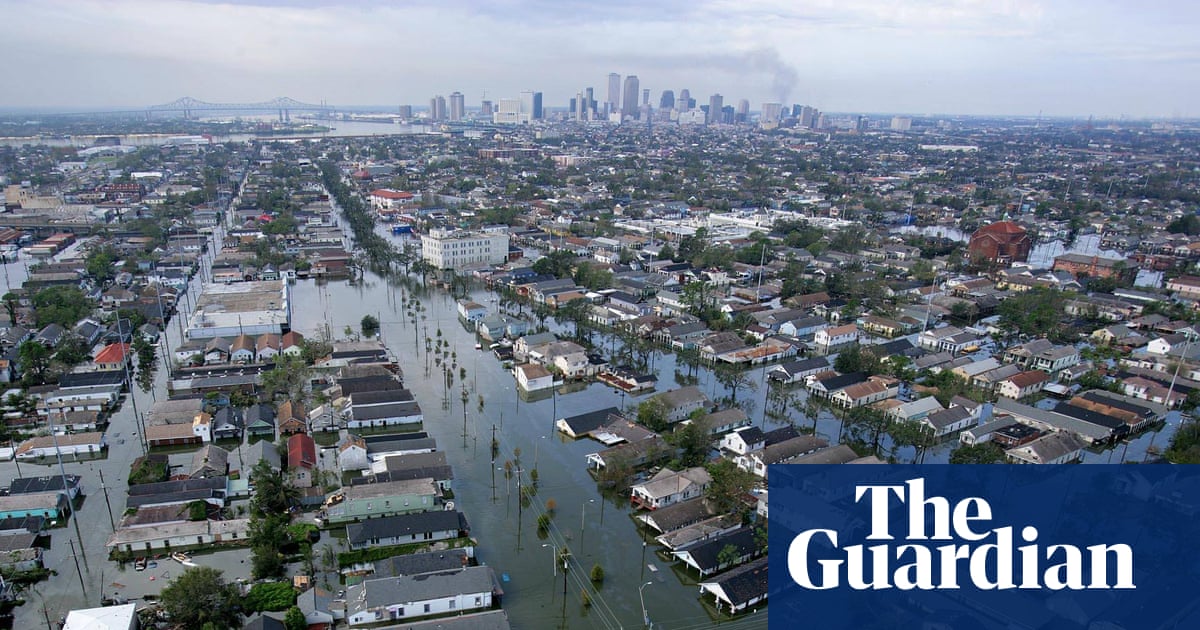
Amazing to think that a southern US government would act sensibly on what they consider a hoax.
Nothing will happen from the official side. But some smarter people will sell their homes to dumber ones, and move out.
Who do the authors think the residents will sell their houses to?
Nice reply essay: Saving New Orleans Is Not Optional
OK, and where does she think the money for this little undertaking will come from? GoFundMe?
Under skies so smoky blue grey.
As the article says, people will just slowly move somewhere else as insurance prices go up. Some relocation plan would be needed only if you didn’t want people to first lose their house to a flood and then move elsewhere with no savings. I don’t think politicians care.
people will just slowly move somewhere else
Moving house is only possible if one can afford to sell their current house for enough money to relocate. In Louisiana, that’s far from guaranteed.
I’m not sure everyone’s rebuilt after Katrina yet.
There are always people dumb enough to move there.
Can’t New Orleans do what the Netherlands did?
Netherlands doesn’t get nearly as many hurricanes.
New Orleans is probably looking more at a Venice situation. Pull out the roads and carve out canals
Just move up to the 1st floor. The roads will turn into canals of their own accord.
That might work if the streets are raised 1 story and the streets become the tidal barrier. This is how the seattle waterfrony was built in some areas.
Imo though I think it makes sense in the long term to just consider the entire area a tidal or submerged area and build/modify accordingly on stilts/pilings and then backfill around just the stilts/pilings.
Roads are too flat and won’t be navigable when partly submerged. Imo thats why it makes sense to build out canals that can be navigated at low tide. The sidewalks can then serve quadruple duty as sidewalk, utility areas, mud barrier, and dock.
Plant tulips?
It’s already doing that. However most of New Orleans is below sea level and that entire part of the state is a river delta/swamp. All of that low lying swampland is receding, potentially leaving New Orleans as a small island out at sea.
You can no longer just protect the city from floods, no longer just reinforce the coastline, you’d have to protect the entire lower part of the state. And it’s not just rising sea level, but floods from the entire Mississippi watershed, and hurricanes. That’s just not reasonable or sustainable
“surrounded by the Gulf of Mexico, by the end of the century”
hate to break it to these researchers, but the Gulf of Mexico has had New Orleans cornered for quite some time.

Gulf of Mexico does not exist anymore by order of the President, so we can safely continue to ignore this…
I’m not convinced that guy’s a real president, so no name changes for him.
Yeah but that looks like a peninsula and it will turn into an island soon enough, hence surrounded.
It will probably turn into sea bottom if another Katerina hits.
I feel like New Orleans will be into being an island.
Venice 2.0 or something
This scenario makes the region the “most physically vulnerable coastal zone in the world”, the researchers state, and requires immediate action to prepare a smooth transition for people away from New Orleans, which has a population of about 360,000 people, to safer ground.
Uhhh…Bangladesh would like a word
oh, they meant “of people the shareholders would be most affected by losing.”
And is it going to happen? Of course not.
Standin’ on the corner
Of Toulouse and Dauphine
Waitin’ on Marie-Ondine
I’m tryin’ to place a tune
Under a Louisiana moonbeam
On the planet of New Orleans…