You must log in or register to comment.
We’re atheists and have raised our son (almost 10) as such, but always answer any questions he has about religion, especially since he hears it in school. He has no qualms telling friends he doesn’t believe in God and one friend told him he was going to hell. This was essentially my statement for him to use in the future andI love that he has no fear expressing himself.
I like what Ricky Gervais said about it. He asked Stephen Colbert if he believed in any of the other 3000 gods from human history. Stephen said he did not. Ricky told him that he just believes in one less than he does.
We evolved into social creatures - apes together strong. The group becomes weak if we are always knocking down or killing our neighbour. If we all work together and gather bananas, then we can feed those in the group who can not gather bananas. Healthy ape brains receive pleasure helping other apes (and animals) in need.
Of course it all falls apart when we have malfunctioning ape brains in the group who promote hate, greed, and fairy stories of a magic sky ape or we have Musk ape, Trump ape and Zucker Ape who want all the bananas.
Interestingly, law is considered a more effective deterrent for immoral people than religion itself!
Religious law and civil law are not very different, the latter is based on the former, historically speaking.
The difference is in who gets to judge and dole out punishments.
Religious law and civil law are not very different, the latter is based on the former, historically speaking.
Hammurabi’s Code disagrees with you.
in theory the difference is dogmatic vs pragmatic but actually civil law is still mostly dogmatic just less so
Nature has essentially built a concept of good and bad into us through evolution. Traits such as cooperation, reciprocity, and concern for others can improve survival and social cohesion, giving individuals who possess those traits an evolutionary advantage over those who are consistently uncooperative or harmful.
You do not necessarily need religion or philosophy to understand the basic distinction between what is good and what is harmful. Human beings already possess psychological mechanisms such as sympathy and empathy that allow us to recognize and understand the experiences of others through our own subjective experiences.
If you understand that something causes you pain, suffering, or fear, empathy allows you to recognize that the same experience is likely to be harmful to someone else. Likewise, if you understand that something brings you pleasure, security, or happiness, you can recognize that similar experiences may be beneficial to others.
That does not mean every individual instinct or emotional response is morally correct. It means that the foundations for morality can exist naturally within the human psyche, without requiring religion or a formal philosophical system to create them.
I don’t disagree with your general point but
Traits such as cooperation, reciprocity, and concern for others can improve survival and social cohesion, giving individuals who possess those traits an evolutionary advantage over those who are consistently uncooperative or harmful
Doesn’t explain animals that are predators like say sharks. They don’t cooperate yet they thrive. You could say that even immorality is an evolutionary trait because it gains you an advantage gaming a system built on trust.
All I mean is you can point at any biological organism and say “the reason it is like this is because it is evolutionarily advantageous” and you wouldn’t really be saying anything more meaningful than “it is the way it is because that’s what’s best for it”. It’s a near perfect example of begging the question.
It’s a bit painting the target around the arrow.
Most religious fundies like this lack a conscious and do no know such things exist in others.
I don’t think that most “lack” a conscience. I do think their conscience is either malformed or severely stunted.
I think, for the ones who are just decent people, it’s more that they misattribute where it’s coming from
I definitely agree with that. They think their conscience is “the voice of God” even when it specifically contradicts their preferred fable.
Is an action good because God commands it, or does God command it because it is good?
If it’s the first one, then all you’re saying is “God commands what God commands,” and assigning “good” to that is meaningless. If God commanded you to do evil things, then you would have to just blindly accept that as “good.”
If it’s the second one, then you acknowledge that there’s a source of morality independent of God that you’re judging God’s commands against to determine that his commands are good. At that point, you’re in the same place as the atheist, and it raises the question of why we need to listen to God as opposed to just going to the source.
This argument literally predates Christianity. But most religious people just think that philosophy doesn’t apply to them and that the answer to every philosophical question is just “Jesus.”
The source is God
If it’s the second one, then you acknowledge that there’s a source of morality independent of God
Good is good. Only thing is deists believe good is a person with intentions for you and everyone to reach himself, to reach goodness.
He helps you if you listen to him, but only if you listen to him. He does not “command” you are fully free to tell him to fuck of at any time
Good is good.
Not an answer.
Let me make this simple. If God shows up in the sky tomorrow and says “murder is good, actually” then is your conclusion, “Oh, I guess I was wrong about murder being bad, it turns out murder is actually good because God said so” or is your conclusion, “Oh, I guess I was wrong that God only tells us to do good things, because God just told us murder is good and we know that murder is evil?”
You’re literally doing the exact thing I described, refusing to engage with a philosophical question and just responding to it with platitudes.
So I guess your question is. Is God good or just pretending to be good ?
Well, you will certainly be very successful not to answer this if you refuse to listen. And that’s the with the rest, you will be better of not listening if your goal is to keep torturing yourself with deeply intricated philosophies.
It is your free choice. At all time
So I guess your question is. Is God good or just pretending to be good ?
No, my question is, again, whether the things God says are good because God says so, or whether the things God says are good because you’ve independently evaluated them to be good. “Pretending” has absolutely nothing to do with anything.
Well, you will certainly be very successful not to answer this if you refuse to listen.
You are the one who’s refusing to listen. I’ve asked you the same question three times now, you still haven’t given anything resembling an answer.
And that’s the with the rest, you will be better of not listening if your goal is to keep torturing yourself with deeply intricated philosophies.
Torturing myself? Do you find it torturous to examine philosophical questions? I certainly don’t. I also don’t think I’m asking anything “intricate” here. This is a simple question that Plato first posed 2400 years ago.
It’s concerning that you’re dismissing this question as some “intricated philosophy” and even more concerning that you call it “torture” to even think about it. There’s this big contradiction right in the middle of your beliefs and you’re desperately trying to pretend it doesn’t exist.
It’s not about listening to me…
Good because god or good then god ? For us and with the level of knowledge we have god is above everything.
But the goal is to reach him. And then what ? What happen when we become like him ? Do we get to see other stuff, things beyond ? I guess ask me again when we get there
Mutual respect, it isn’t fucking difficult.
It starts with “I don’t want to die so if you won’t kill me, I won’t kill you” and just incrementally grows from there.
That Golden Rule. If you wouldn’t like it done to you, don’t do it to someone else.
absolutely wild how many people out there will blast me with eye melting LED headlights and then get all pissy when I turn my halogen highbeams on
I think they missed the memo
I also hate how bright modern headlamps are and agree that it’s a potentially painful annoyance at best, and a huge safety issue at worst.
If you’re in the U.S., a study has been mandated and a bill introduced to take steps towards setting brightness limits for auto manufacturers. If this is an issue you care about, consider reaching out to your Congressmen and let them know you want them to support the bill and study mandate introduced earlier this year:
https://www.congress.gov/bill/119th-congress/house-bill/7772/committees
https://gluesenkampperez.house.gov/posts/gluesenkamp-perezs-amendment-passes-house-appropriations-committee-to-investigate-overly-bright-headlightsMost drivers don’t choose how bright their headlights are or how they’re calibrated. Most modern vehicles come with super-bright LEDs, and because of the popularity of larger SUVs and trucks (which is a different conversation) those lights are about a foot higher off the road. Realistically, we can’t expect individual owners to replace or modify factory headlights on their own. If we want the problem to improve we will need stronger industry regulations or financial incentives.
or how they’re calibrated
one of the first things we learned in auto shop back in school was how damn easy it is to properly aim headlights. you turn two screws/bolts. bugs the shit out of me how it’s never done anymore.
calibration, unfortunately, only helps on smooth flat ground when aimed at stuff on the same plane
there’s a McDonald’s drive through that I go past sometimes that is right next to oncoming traffic but 10 ft higher in elevation, and I fucking hate that thing. I just hold my horn down whenever somebody is sitting in there with blinding headlights so I can’t see if somebody is turning across my lane at the intersection just ahead. they still haven’t put something up to block headlights. maybe if more people get on the horn they’ll finally do something about it
@mrgoosmoos @HeyThisIsntTheYMCA
I’ve heard that most of the cars in the rest of the world have some sort of mechanism by which their lights will not shine directly at the faces of drivers in other cars. But of course here in the US we can’t have that.
matrix headlights are only suitable for environments where vehicles are the only other things that will be encountered, like highways
they don’t work for pedestrians or cyclists, and they’re not quick enough to react on hilly or windy roads
great tech for high speed highways, not appropriate pretty much anywhere else. it’s not the loss a lot of people think it is, to not have them in North America
I thought that was the Silver Rule.
Penn Jillette has a good explanation. I don’t agree with a lot he says, but this is pretty spot on. (The clip goes kinda off the answer after about a minute)
tl;dw: If you I don’t believe in a god, what’s stopping me from raping and killing anyone I want? And the answer is: I have. I already have. I have raped and killed everyone I want to rape and kill, and the answer is… zero. There are zero people I want to rape or kill. And the question becomes: Who are these people walking around with lists of people they want to rape and kill? Why do we consider THEM the sane ones?
Had I been alive during WW2, I’m pretty sure myself and majority of my neighbors would have Hitler on the kill list.
I for example do not poke my eyes out with a fork… Because doing so it bad. It’s actually really simple to decide if something is bad. Much harder to decide something is bad and then realize it’s good and choosing it because it is good. I change mind all the time. Science too, it’s part of science. You see 👀 results from a test and you realize you were either right or wrong and then you test again… Something different.
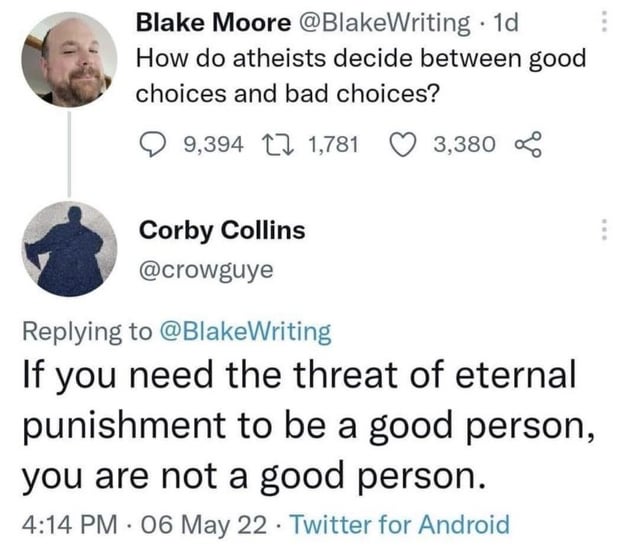
How do atheists decide between good and bad choices?
Well, some of them are dumb, and they just guess based on what’s best for their survival at the moment.
The clever ones employ something called “critical thinking”
(I went to Christian schooling for my entire childhood. I first learned about “critical thinking” and the scientific method when reading an Edmund Scientific pamphlet. Blew my mind… in my mid 20s).
deleted by creator
Good people sometimes do bad things, and bad people sometimes do good things. But the real kicker is that people aren’t truly good or bad, it’s a false dichotomy.
Well, there is good as in beneficial and bad as in detracting. As my dad said, “about 85% of people are just trying to live their life, not bad or good, but there is the other group that is troublesome” — black markets, affluence against commoners, etc.
Let’s be honest, they do so by adhering to cultural norms with the exact same devotion and lack of scrutiny that religious people do.
“Why do we do it this way?” “We’ve always done it this way!” “Why is it wrong?” “Because it’s just wrong!”
The very small subset of actually moral people decide between good and bad choices not depending on social norms, not depending on laws, not even depending on morals or ethics, but by what motivations their actions arise from, whether they come from Ego or understanding.
You can never know whether an action is good or bad, you can only know whether your motivations are good or bad.
Religious people act like they’re more moral or have morality that’s special because they believe in God. However when you ask why all those pious people back in the day: cheated, stole, murdered, adulterer, were racist, had slaves, raped kids and stuff. They would say that it was the norm at the time and nobody else knew better.
To paraphrase Stephen J Fry: “then what are you for?!”
Sure, but so do atheists. They just believe their morality is special because they believe in the current social norms, within the current societal context. In 10 years they’ll be different, should a catastrophe happen it will shift completely. It’s just as flippant in its own way.
There’s pretty solid evidence supporting empathy as a beneficial evolutionary trait, it’s not like it’s random that “don’t be shitty to each other” is a social norm.
But social norms aren’t empathy. They are adhered to because of the punishment that will result if you break them. Before you have any chance of developing empathy or emotional intelligence, you are taught as a child that breaking social norms will result in punishment, and from then on your only motivation to follow them is fear of punishment.
And that is exactly the same mechanism as religious morality.
you are taught as a child that breaking social norms will result in punishment, and from then on your only motivation to follow them is fear of punishment.
I didn’t give up meat because I was worried about angry vegans coming to my house and beating me up, I gave up meat because I rationally evaluated the effects eating meat would have on the world and determined that those weren’t effects I wanted to cause.
Am I just built different?
Yes, in all likelihood you have some kind of neurodivergence. That’s why you’ve probably noticed people around you rarely function through rational choice the way you do.
People are generally programmed to follow the tribe, keep opinions to confirm and demonstrate fealty to the tribe, and to avoid committing any taboos that could cause them to be cast out and die alone in the wild.
And the people who did not do this mostly just had this exact happen and died.
I am neurodivergent, but I’m not prepared to accept the implication that neurotypical people lack moral agency. Anyone is capable of thinking critically about their behavior and changing it. Not every vegan is neurodivergent.
you are taught as a child that breaking social norms will result in punishment, and from then on your only motivation to follow them is fear of punishment.
I’m sorry to hear about your sociopathy, but no this is not how most people work.
Deflection beats introspection, eh? It always amazes me how easily insults come to the “morally righteous”.
At least now you know how people become bad - they don’t have the courage to question whether what they’re doing is actually good.
It’s not an insult It’s illustrating the ridiculousness of your claim. Your faux-intellectual philosophy is not convincing.