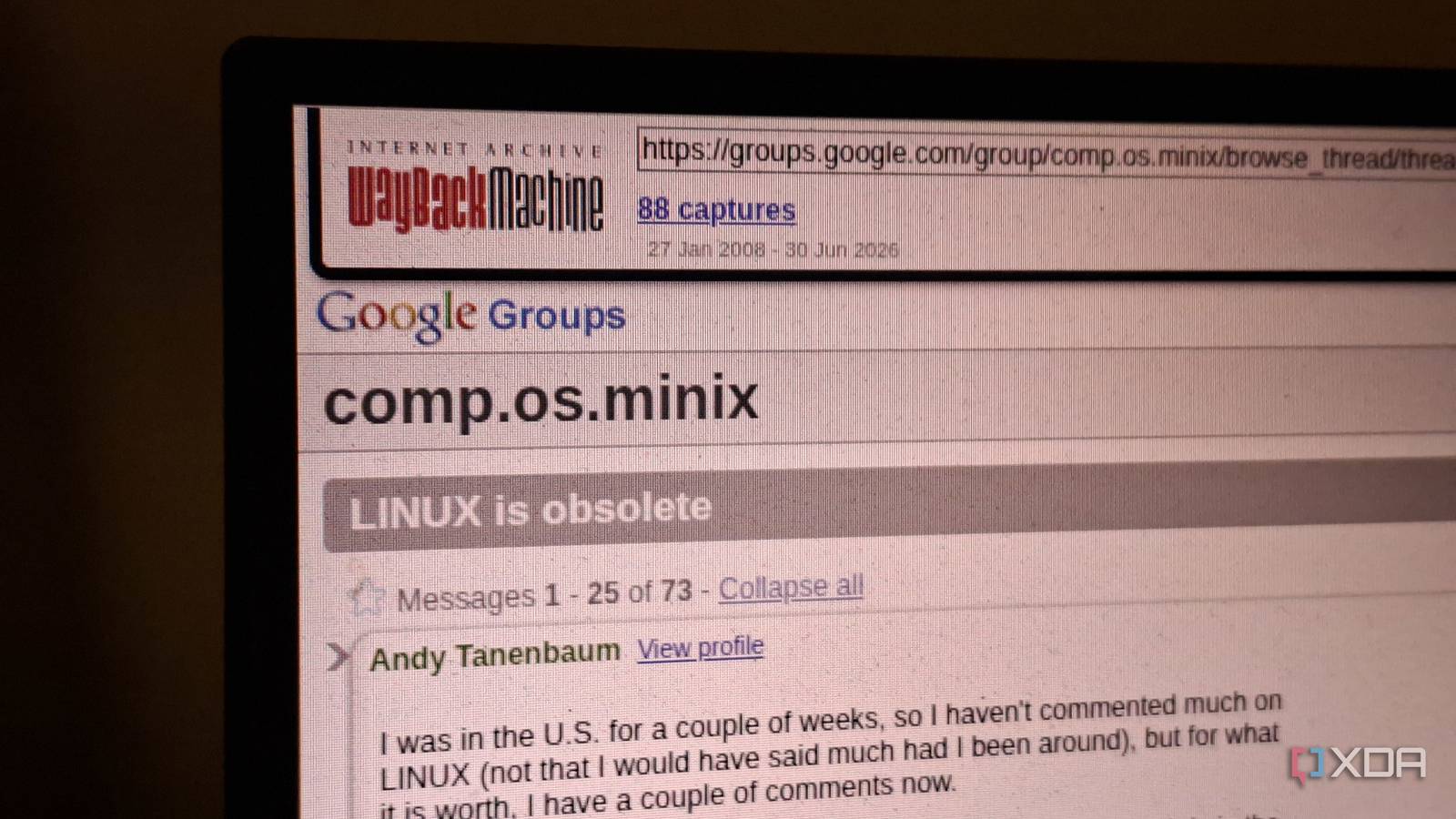
Remember Windows Server? LMAO
Not only Servers… Most of the VR Headsets, many TV’s, most mobile phones, a lot of automation systems, etc.
TBH a lot of Posix API stuff are designed around now obsolete hardware limitations, but nothing that can’t be solved with some committee, that will design a new API, by committee.
Tanenbaum laid out why his hobby OS beat out Linus Torvalds’ own pet project.
The primary reason why Linux beat out Minix, is that Tannenbaum wouldn’t allow Minix to win. There was a desperate need for an open source Unix-derived OS at the time, and many people wanted Minix to become that, but Tannenbaum wanted to keep it clean and educational. FreeBSD could have been it had Linus not created Linux, but he did so at exactly the right time for it to be embraced by the community and launched into the stratosphere.
It’s more to the credit of RMS, who was looking for a kernel to join GNU. And he picked Linux.
1989 was when the GPL was written, so this followed a few years later.
There’s no single individual that made it happen, but no doubt that Linus and RMS were the two biggest. Bear in mind that there were lots of additional contributors to the kernel and GNU as well.
I also think Red Hat was also one of the biggest contributors to Linux’s success. So many of the most important technologies that we use today came out of RH. I don’t have a lot of love for them today, but their contributions in the '90s and '00s was immense.
I actually think that a large part of the reason why PCs are much better open platforms than mobiles is because there is no Red Hat of the mobile ecosystem. Google started it out with AOSP, but then closed it up when they monopolized the market. Makes you wonder if RH would have done the same if they had the same kind of success.
Aosp is still open?
Launched into the stratosphere is the perfect phrase for it. It’s had decade after decade after decade of crazy effort put into it. I’m sure that when looked back on from a future era it will be remembered as the first true example of human collaboration without boundaries. Kinda neat
“was called obsolete” - by 1 person who happened to be the developer of a competing OS/kernel.
Tanenbaum also believed that the Intel x86 was on the way out, the very CPU that Linux was hard-coded to run on. On the other hand, Minix was ready to adopt the upcoming RISC tech, which Tanenbaum believed would drive the x86 into extinction.
A genuine Nostradamus, here.
Kinda wish he was right about risc tbh
I would argue he was, but it’s taking far longer than I’d like
Depends if you count ARM too. I was always confused between RISC and RISC-V, and what ARM has anything to do. As I understand ARM is based on RISC, but its closed source. And RISC-V is based on RISC, but open source. Is that correct?
IBM PC and Apple Mac are both based on the same thing: the idea of a personal computer. IBM PC even put “PC” in the name.
You can definitely tell that they were designed with similar principles in mind, but they are not in any way compatible on a technical level.
ARM and RISC-V are both based on the same thing: the idea of a reduced instruction set. RISC-V even put “RISC” in the name.
You can definitely tell that they were designed with similar principles in mind, but they are not in any way compatible on a technical level.
ARM is absolutely RISC. It stands for Acorn Risc Machines (or maybe it’s “Advanced” now?), and was even then a very cool and promising idea, although it lagged behind in speed for a long time. Until the StrongArm came out, I think.
RISC isn’t a specific architecture, but moreso a design philosophy.
So is ARM. Every ARM processor is basically uniq, and that makes it efficient. That’s the point of it. RISC as a design philosophy doesn’t take over the industry, its specific implementations. My question is not what RISC is, but if ARM is based on RISC and how close it is in their designs to RISC-V. As I understand the company behind ARM took the RISC philosophy and created a closed source system.
ARM is a well-defined instruction set architecture (ISA), that in order to implement, must comply with that instruction set and be compatible with other implementations from other vendors.
RISC is not any sepcific ISA at all, but is rather a more generic term for any ISA that has a small amount of instructions.
RISC-V, on the other hand, is a well-defined ISA whose implementations are intercompatible with each other. RISC-V is a very specific, royalty-free ISA that comes out of UC Berkeley that adopts the RISC philosophy.
Interesting read: https://www.dfrobot.com/blog-13483.html
And was Linus’s teacher for Operating Systems in HelsinkiWrite the book on Operating Systems that Torvalds said inspired him to make Linux.
At university?
You mean docent I presume. Universities do not exactly have teachers.
Resident or visiting?
edit: in my country docent is the normal term for people giving lectures at universities. Or prof, but not all of them are actual professors. Seems I - once again - got caught up in translation. You native english speakers do you! But universities - even in english speaking countries - work differently from schools. To put it shortly, it is up to you to teach yourself from the material you get from lecturers. So in a way you are your own teacher.
Besides, I made this comment to reply to a doubtful statement, which the commenter almost immediately retracted (but didn’t delete completely to their credit).
… I’m curious how many more replies this will attract.
Universities do not exactly have teachers.
Now, some professors might hate this, but hear me out… If somebody’s teaching, they’re a teacher, how about that?
Nobody teaches at universities?! Must be a wild place to try to learn.
Tell me you’ve never been to a university without telling me…
You have to know that there are multiple terms for people that teach at a university around the world, and that “docent” is not the only possible term.
Like I’ve never heard a professor referred to as a “docent” in North America. Docents here are information guides in museums and galleries.
That’s fine, I’m not discussing terms.
But a statement like “Nobody teaches at universities?! Must be a wild place to try to learn.” makes it clear that you do not understand the difference between a school and a university.
You thought that statement was straight, and without any irony? Did you forgot the context of your own statement of “You mean docent I presume. Universities do not exactly have teachers”? Universities definitely teach how to keep context in mind, especially when irony and satire is involved. What happened here?
Also that wasn’t my statement.
You went to a teachless university?! That’s certainly a choice.
I think universities do have teachers, but that’s beside the point.
Anyway I misremembered and it was just that Tanenbaum wrote the OS book that Torvalds had during undergrad.
Docent makes me think of guides at museums. When I was in uni (well, I called it “college”, being from the US), the usual title was “professor”. But if you’d asked who my teacher was for a particular class, I’d have known what you meant.
Windows was called obsolete (by me) years ago, and it’s abandoned (by me) since mid 2024.
That statement really has the same vibe as the one in the post. Well done.
In 1987, Bill Gates predicted in an interview that in 3 years time, 80% of new office systems would be based on OS/2, an operating system from IBM.
The first release of Windows was in 1985, so that Computerworld interview was basically Bill Gates calling Windows obsolete.
deleted by creator
I mean, from what we learnt on university the “messiness” of a monolithic kernel seems “wrong” and a microkernel arch seems “better design”. Once you spend a couple of decades in the workforce and opening your mind… I haven’t seen a single “good modular design” that doesn’t suck balls, super bloated and with many performance issues just to make it “pretty”.
So, while I’m not claiming it doesn’t exist… I think is at the very least debatable.
Also, in 1992, when this article came out: you couldn’t just walk into Walmart and get a CD with Debian or Slackware on it (still cant but thats another story). If you wanted the latest reliable word processor, email, hardware drivers and access to excel you basically had no choice but to slap down $100 for a Windows or OSx install. Only enthusiasts, academics and scientists had the bandwidth capacity to download and update an entire OS in 1992. CD burners themselves were $10 000 in 1992.
TBF, in 1992 you might have had a hard time getting slackware at all since it was officially released in 1993.
However, when I first used it around 1997, it was just a stack of floppies, no CD needed.
That’s painful. I had a proper purchased slackware 3.1 CD in 1997.
I tried a two-diskette non-distro from “so much shareware 2”. I think it was minted in 1993 and labelled Linux 0.99b
It might not have the relevance that Linux has gained, but Minix is an operating system that you can run today. Ymmv.

You know this is actually kind of funny, cause I think it might be very possible that the roles between Tanenbaum and Intel could hypothetically be reversed.
There was a controversy a couple of years ago, with Wizards of the Coast and D&D, where they were planning on making a bunch of really bad and sweeping changes to the Open Gaming License. One of the controversies had to do with the license not having language for irrevocability, which Wizards believed allowed them to go ahead and deny people the right to make use of the old OGL moving forward, forcing everyone who publishes their OGL content to adhere to their new, more restrictive, license terms.
They never moved forward with the bullshit because the backlash was that bad, but supposedly licenses are not irrevocable by default, and so any license that lacks explicit language granting irrevocable rights can be susceptible to the same rug pull that WotC almost pulled.
And the last time I checked, guess which super permissive license does not grant irrevocability?
It’d only work if someone did it with some PITA dependency that no company wants to actually throw resources at, but it would be hilarious to see Intel or Amazon make a big hissy fit over a random MIT project used in millions of systems getting revoked lmao.
Bonus if it affects Amazon because they already refuse to use AGPL software lol.
The thing that concerns me is the precedent it can set. At least according to this source, MIT is about the 3rd most popular open-source license. If one rightsholder decides to pull a WotC, how many will follow suit? Honestly think that license is a potential minefield.
(And just want to point out, this is not a matter of permissive vs copyleft. I think it’s more a question of competency. The MIT license is just not a very rigorously written license from a legal standpoint. If you are a dev who wants similar features to the MIT but more carefully crafted, then the Apache 2.0 license is probably what you want. Otherwise if you want the closest thing to opting out of Copyright all together, then the Creative Commons Zero public domain pledge is your best choice).
And lastly, the Hippocratic License is worth looking into if other ethical considerations are something you need as well.
Need more pixels. I can’t read any of that text.
That you do run today (even though you don’t know it), most likely.
If you have a modern Intel processor. Some of us went AMD to avoid all that, although it’s not exactly clear what’s running in the negative rings of those either.
Doesn’t AMD run Minix? What other such systems could it use?
… and millions of phones 🙃
And your car and likely your fridge too. Linux is everywhere.
deleted by creator
I mean, if it were for novelty and “cleverness” then it would be Plan-9 (or BeOS) the one who shoulda take over. At the end of the day both Linux.and Minix are both following the UNIX model which even at that time it already was “obsolete”. But reality is often more pragmatic
The point was microkernel vs monolith
The Cathedral or the Bazaar?
ESR is an asshat.
I’m a bizarre cathedral fan in my heart though.
Honestly plan9 is neat but it suffers from being incredibly stringy and so does Linux / unix.
There’s some new paradigms out there that probably need to be uncovered. Computers have way more processing capabilities then they did in the 90s
More processing power means new paradigms are less likely to be uncovered, I think. The deficiencies of current designs are obscured, and maybe moot, due to the raw power the processors. There isn’t any real pressure to improve kernel design.
All of the big current kernels (NT, Linux, XNU) are rooted in the i386 era. There’s certainly been a lot of changes in all of them but I don’t know if any have been completely re-architected.
Might have to wait for some kind of completely new processor before we see completely new kernels.
It’s not a processing problem, it’s a interface problem. Somethings are just easier to use or more functional based on how they are built.
Take a look at nixos, the large increase in compute has allowed for smarter package managers that can do complex validation.
Or rust for example and it’s compilers. It’s more expensive to compile then something like c but there’s lots of benefits to its model.
Just because old things are cheap to do doesn’t mean they can’t be advanced. Everything is a give and a take.
It powers servers, smartphones, a growing number of personal computers, and at least three gaming consoles (Deck, Machine, Legion Go S), with more coming.
Tanenbaum is still around
“…but ‘vector’ is a useless survival, or offshoot from quaternions, and has never been of the slightest use to any creature.” - Lord Kelvin
And it captured our hearts along the way. I bet few of us knew it existed in '92.
I had no clue how to operate a computer in '92. Pretty sure I had no clue what MSDOS was, much less what Linux was. Was a few years later that I actually got my first PC and started to learn stuff.
How? Torvolds released the Linux kernel in 91, lol.
Oh, maybe because UNIXWare 1.0 (System V 4.2) came out in 1992, the first major release in years. :P 🖕