You must log in or register to comment.
I left the hospital with a drain in me.
Had to follow up to get it taken out - they only did drain removals one afternoon of the week. Something that took me thirty seconds to do when I got fed up and did it myself.
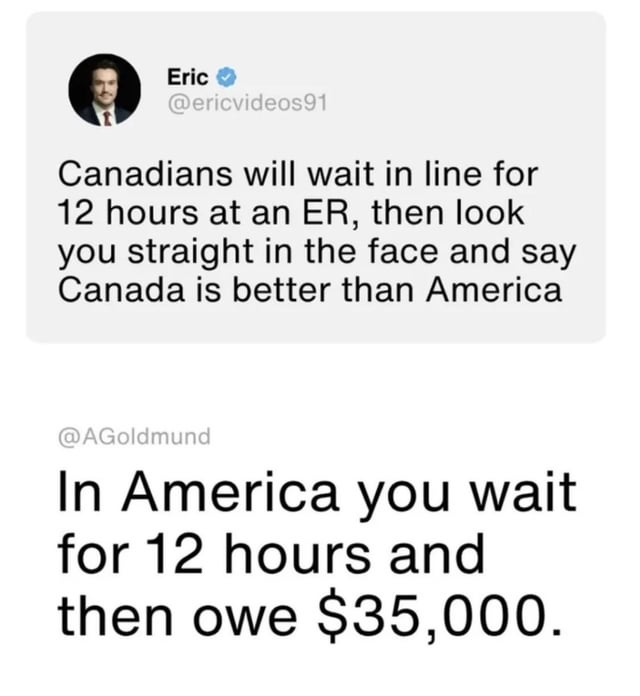
For the non-Americans out there:
This isn’t even an exaggeration. This was literally my exact experience going to the ER after I got fired.
What would happen if everyone cancelled their health insurance and stopped paying outrageous surprise medical bills?
Because doing the “right” thing and hoping it will get better someday isn’t working very well.
Some people would die. In the end the survivors would be far better off. Question is mostly how long it would take. Could the medical/insurance industry make it without changing a thing for more than a month without health insurance? More than half a year?
Some people would die.
That’s the hard part. But as a random pedantic internet asshole, I have to point out that the current system is also causing deaths.
$35,000 USD for surgery is on the low end. The US healthcare system is a complete shitshow.
The post doesn’t mention surgery; it’s just the ER trip.
I believe it means $35,000 AFTER insurance.
Just out of curiosity, what are American wait times like for the uninsured? Infinite?
Your insured status has (allegedly) no impact on wait times in the US.
They’ll hound you for payment while you’re actively being seen by doctors, but they won’t delay you just because you can’t pay.
- Have been to the ER uninsured in the US
Personally, I’ve never had particularly long waits in the ER, but I only ever went to the ER when something was seriously wrong.
But it can really depend on where you are, time of year, holiday weekend, etc etc. Hospitals do triage, So chest pains and broken legs tend to be seen before someone there with a runny nose, and the runny nose person will probably have a significantly longer wait time than someone coming in with the left side of their body sagging and uncontrollable. .
It depends on the situation. Emergency rooms are required by law to stabilize emergency medical issues, regardless of the patient’s potential ability to pay. This is because there used to be a big issue with ERs dumping non-paying patients. If the hospital didn’t think a patient could pay, security would literally wheel them across the street, then just leave them there to figure their own shit out.
ERs run on triage, (and lots of people go to the ER for things which could be handled by an urgent care or family doctor instead), which means wait times entirely depend on your specific situation. Mildly upset stomach? You’ll probably be waiting at least a few hours, especially if it’s a busy night with lots of more urgent patients. Chest pains with a history of heart disease? You’ll have EKG leads stuck to you before you’re even finished telling the intake nurse what your issue is.
And the big key thing is that ERs are required to stabilize an emergency medical issue. They aren’t required to provide follow-up care, long-term support, etc… If you show up with a cut that needs stitches, they’ll stitch you up. But they’ll tell you to follow up with your regular doctor to make sure it’s healing properly, and to remove the stitches in a few weeks. Don’t have a regular doctor because you’re uninsured? Good luck, hope it doesn’t get infected, then maybe chew some Tylenol and remove the stitches in your bathroom.
ERs run on triage, (and lots of people go to the ER for things which could be handled by an urgent care or family doctor instead), which means wait times entirely depend on your specific situation. Mildly upset stomach? You’ll probably be waiting at least a few hours,
Canada is the same, I went in bleeding badly and was seen right away. But another time I went in just needing my finger sewn and it took around 3 hours to be seen.
Currently, emergency rooms are bound by law to provide care to all patients, regardless of insurance status. Busy emergency rooms will triage patients, ensuring those who need care the most get it first. Unfortunately for uninsured patients, the hospital will hand them a bill as they leave; something simple as wound cleaning and a few stitches will run upwards of several thousand dollars. That total can exceed tens, if not hundreds of thousands of dollars depending on level care and length of stay.
A family member of mine recently had a medical episode while we were at a restaurant. Spontaneous syncope followed by prolonged lightheartedness and loss of balance. The ambulance ride to the hospital alone cost over $7000. They arrived at the ER around 4pm and was released shortly before midnight. Within a couple hours of arriving my family member felt and that they had fully recovered, but the ER would not release them until a doctor was available to discuss test results. Around 10pm the doctor finally called them back; they found nothing out of the ordinary in the blood work, heart seemed to be working fine. We waited two more hours before they gave the okay for release.
The bill for the ambulance, ER care, and about a baker’s dozen of various fees and incidentals, was over $23000. Thankfully they had insurance, which covered most of it, but they still had to pay several thousand out of pocket for going to an “out of network” hospital. That alone is infuriating because not only is the entire concept of in-or-out of network medical providers a predatory practice, the choice of which ER to go to was up to the paramedics, it was never up to us. Even if it was up to us, we had no way of quickly knowing which local hospitals, if any, were “in network.”
No, just like anywhere else, wait times are based on urgency. A severed limb will be taken instantly, a bloody nose will wait until there’s an empty bed. Doesn’t matter if you’re insured or not.
Uninsured will just get billed a full amount after the fact (payable in installments to the hospital), vs insured who might have to pay a copay, and then a few month later will get billed a reduced amount, after the insurance company chooses what they’ll cover.
I speak from experience. I was uninsured for a short time, and of course my appendix chose that time to rupture. I was admitted and in the ER instantly. Spent three days recovering in the hospital. Before I left the hospital had a bill for me. It was very high. I set up a payment plan. Eventually I stopped making payments, because I was broke. Hospital sent my bill to a collector. I blew them off.
Was unable to get a loan for a house for 10 years.
So insane that they see “oh he didn’t pay 10s of thousands for an unexpected medical debt, must be irresponsable with money.”
It’s largely because the “tens of thousands” is usually a result of being uninsured. And if you’re uninsured, it’s usually because you’re unemployed. And lenders tend to get squirmy at the idea of giving a loan to anyone who hasn’t been fully employed since the day they were born.
There was actually a rule implemented by the Consumer Finance Protection Bureau shortly after the pandemic, to prevent medical debt from impacting your credit history. Because lots of Americans were suddenly finding themselves in an awful job market with tons of medical debt from being sick. But last year, the fifth circuit court of appeals (the one that presides over Texas and Louisiana, and which is stacked with conservative judges as part of the Southern Strategy) voided the rule and allowed medical debt to appear on credit reports again. The ruling from the conservative court also prohibited the CFPB from implementing similar rules in the future.
There was actually a rule implemented by the Consumer Finance Protection Bureau shortly after the pandemic, to prevent medical debt from impacting your credit history. Because lots of Americans were suddenly finding themselves in an awful job market with tons of medical debt from being sick. But last year, the fifth circuit court of appeals (the one that presides over Texas and Louisiana, and which is stacked with conservative judges as part of the Southern Strategy) voided the rule and allowed medical debt to appear on credit reports again. The ruling from the conservative court also prohibited the CFPB from implementing similar rules in the future.
you have to wonder what kind of soulless, hateful, worthless pile of shit roughly packed into a humanoid shaped bag would look at medical debt not ruining peoples lives and go “You know what, thats not right. people need to be more fucking miserable” and sue to get it overturned.
I imagine it was something like “but the lenders deserve to know if you were in medical debt ever!! They didn’t save millions in case anything went wrong ever!!”
That’s a great username btw
medical debt should never end up on a credit report.
Of course medical debt shouldnt exist as a concept. Funny how all but 1 of the major countries on earth have figured this out.
If your leg is hanging off you don’t have to wait 12 hours. Idiot don’t know about triage
It’s unfortunately common for some to assume that they are the only sick person in the entire healthcare system.
Um, excuse me! Don’t you know how important I think I am!
Yeah I don’t hear the long waiting lines argument anymore
A comparison of Canada vs the USA is hard. All my instruments need to be recalibrated for imperial shithole country scales, but the conclusion is always the same: THE USA SUCKS.
The only issues with Canadian Health Care system is american capitalism and “business”.
12 hours and $35k? Stop your bullshit. I’ve dealt extensively with healthcare in the US. It’s more like 10 months and $110k.
My partner is literally waiting 10 months to see a rheumatologist for debilitating joint pain. A virtual visit, no less.
Last year my best friend got diagnosed with cancer, and his VA docs let him sit 3 months between appointments. By the time they offered a treatment plan, he had become terminal, almost a year in. He died last June. It’s really quietly horrifying to see it play out in real-time.
My ex got diagnosed with stage 4 cancer and was cured in a few months. Canadian, here.
But on the bright side, the insurance company probably saved a lot of money. And as you know, line going up is more important than quality of life going up or even staying alive. /s
I’m sorry about your friend, nobody deserves that.
He said VA. No insurance there.
That’s heartbreaking. I’m so sorry for your loss.
To be fair I had to have an organ removed due to exploding or something. It took less than 24 hours. Then insurance denied it-no way to tell if said exploding organ was an elective surgery or required by the doctor who required us to do it.
Apparently all the cool kids are doing elective organ removal these days.
The American healthcare system killed my grandpa by waiting so long to care for his severe foot infection that his heart (which was already damaged from a heart attack 15ish years prior) couldn’t handle the strain anymore and he passed away. I will never forgive that hospital or the insurance companies involved, and I never even got to say goodbye to him. That kind of shit doesn’t happen as frequently here in Canada and I am thankful for the system we do have, flaws and all.
Look, some sacrifices are gonna have to be made if we want to continue having the best healthcare on earth.
Fortunately, we’ve mastered the sacrificing part, now we just have to tackle beginning “to continue having.”
Are these doctors just seeing patients all day, every day? If not, I can’t imagine how they could possibly justify making someone wait 10 months for a virtual visit.
A rheumatologist? Basically. Any ‘old person’ specialty is hard to get an appointment in because they’re booked out for ages, unless you’re lucky and live near a bunch of them or have insurance with a really big network of providers.
Honestly? A lot of them are. They also might have a few hours during the day where they review lab results or imaging for their various patients.
A lot of the specialists don’t work for a hospital or anything, so they’re basically a doctor and also a small business owner in a business with a very long ramp up time and uncertain demand on the timeframe that you can make the decision to work in the field. So you end up with “how many people do you think will have arthritis in five years, and how many people do you think will have decided to become rheumatologists by then?” And if you’re wrong you’re still a rheumatologist and you basically just need to move someplace that needs one and hope you can run a business.You might luck out if you’re near a big medical facility that’s involved in teaching, because then you might end up with several doing teaching and research.
It can easily happen anywhere.
E.g. in the UK, someone I know had to wait 18 months for an (online) assessment for ADHD. I was along as a character reference, since I have ADHD myself, so could point out the bits they forgot (due to ADHD).
At the end, they apologised again for the delay. Apparently, since COVID, they have been receiving almost as many referrals in a week than they used to in a year. It takes a long time to train new doctors, particularly in specialist positions. They were swamped.
Many specialists are in the same boat, even before insurance companies get involved.
Are you saying people are sitting around waiting at the emergency room for 10 months at a time and it’s a regular thing in the US?
They send you away for everything except imminent death. You then have to book an appointment with a specialist instead, and it’s at least a month from now.l if you’re lucky.
Some fellow Canadians bash our system but usually its those that don’t get what triage is.
Like my wife felt Ill we went to emerge, maybe waited 4-6 hours. Low blood sugar doctor recommended eating higher protein snacks in between meals.
But when they figured out I had cancer it was fast track for everything.
No point in explaining. If you go to the ER in America you’re waiting 12 hours, at least, unless you’re actively dying.
Oh and it will cost you a nice new car.
When the Australian Emergency department keeps me waiting for less than 15 minutes, I really start to worry.
Yeah the reason I haven’t waited that long in the ER isn’t because I’m American. Ok actually it is, as an American I’m not going to the ER unless I’m certain I have to. Head trauma, blood loss, issues breathing, anaphalaxis… I think a bone might be broken? I can go to the urgent care in the morning
And that is just the referral
People who think America has better healthcare are either wealthy, or don’t have any health issues they deal with regularly.
Even upper middle class Americans have shitty healthcare. But many or most of them are proud of learning the system so they refuse to consider that they could have been getting fucked their whole lives.
That’s a good point. If I had a dollar for every time someone smugly explained a horrific aspect of American healthcare like I’m an idiot for not knowing it, well, I still wouldn’t have enough dollars to go see a doctor, but it has happened a lot.
Or they haven’t experienced healthcare elsewhere, so all they have for comparison is what pharma is talking them
When I went to Econ class, the professor explained that we call it “Free Market Economics” because of four freedoms:
- Freedom of entry and exit - participants (buyers, sellers, and prospective such) can enter or exit the market at their leisure, and the market will not change
- Freedom of participation - every participant is in the market of their free will and can leave the market without repercussion
- Freedom of substitution - every product on a particular market is essentially the same
- Freedom of information - every participant has the same information about availability and prices at the same time
The reward is that free markets are efficient: they lead to the lowest prices and greatest exchange of goods. That is the reason we have them.
When the four freedoms are not mandated, the market fails in different ways, and that’s absolutely expected. When information is available to some before it is to others, we get price distortions - that’s where insider trading laws come from.
Health care, the prof explained, suffers from the fact there is no freedom of participation. You either buy care or you suffer the potentially deadly consequences. That’s why free markets and health care are fundamentally incompatible: they are expected to be.
Healthcare is the literal example of inelastic demand my prof used to teach us the concept. If you die without it, then there is no price where a reasonable actor can choose to stop participating in the market.
Well, it’s a little elastic.
Non-fatal health conditions that lots of people put up with. Someone I knew went to ER for first kidney stone, then just endured the pain the second time until they could get a non-emergency appointment, since it’s non-fatal but agonizing, and a non-emergency visit is like 80% cheaper.
Lots of people just accept chronic problems, for example joint pain without seeking medical examination.
Of course, in many cases, hard to make an informed decision on whether it is or is not one of those life or death scenarios in many cases.
Yeah, but that holds as much water as my argument in macro 100 about gas being elastic because of how many people scoff at the shell price and look for a sunoco. I did it when I drove every day (in a city with a high density of gas stations), and I will now take other forms of transportation if gas is too expensive, but that’s not common behavior, nor is it normally logical (saving five cents per gallon, driving an extra five miles, and wasting twenty minutes is not a true savings for most people).
It’s technically true, but in an academically idealized market, it wouldn’t be.
I feel like #3 no longer exists for anything in the US economy. You get one product in each niche either owned by 3 companies whose executives all have lunch together (egg farms, meat, ram manufacturers, etc) or where its just absolutely so black boxed its unclear what the product actually is (windows, google, ai etc)
#4 is on the way out too. USA! USA! USA!
That’s why monopolies are supposed to be illegal.
Its also why pricefixing is illegal.
There’s no freedom of information either. Good luck getting your healthcare provider (your doctor, the hospital) to tell you how much any given procedure will cost in advance.
Are free markets efficient? I think that’s an open question.
#4 Doesn’t seem to be a thing anymore, president seems to get away with all the insider trading he wants PLTR tweets and what not
I believe it’s called inelastic demand: things you don’t stop buying even when prices go up.
See also: housing, food (though you may eat less or eat other foods, but you still need food).
Cut my finger off twice, almost lost my foot to sepsis whilst camping, and was witness/transport for 2 different heart attacks.
Longest I’ve waited for serious treatment is about 5 minutes, most expensive was a 50$ parking ticket.
You’re being fleeced like fools
So, out of curiousity, do you work as a sword juggler or is it more of a hobby?
Bro take more precautions
same one or nah
Left thumb and left middle.
Different tools. Multiple years apart
Shame you didn’t chop them at the same time you could have switched them and had a middle thumb
Where is your God now?