- cross-posted to:
- mushrooms@lemmy.world
- cross-posted to:
- mushrooms@lemmy.world
You must log in or register to comment.
Looking over the wikipedia page on this mushroom and all the similar, very edible ones…Yeah I’m never foraging mushrooms.
Yeah, I carefully read the description of its distinguishing features, studied the photo, and concluded I have no idea what I’m looking at and how to tell them apart.
I’m really good at spotting differences or inconsistencies, I’m totally lost with mushrooms though, and I go multiple times every Autumn with a woman in her 70’s. She is very clear about what we are looking for. She throws out at least half of what I gather.
Cool, I think you just saved me a bit of time.

chanterelles are pretty safe to forage if they grow near you.
they are very distinct looking.
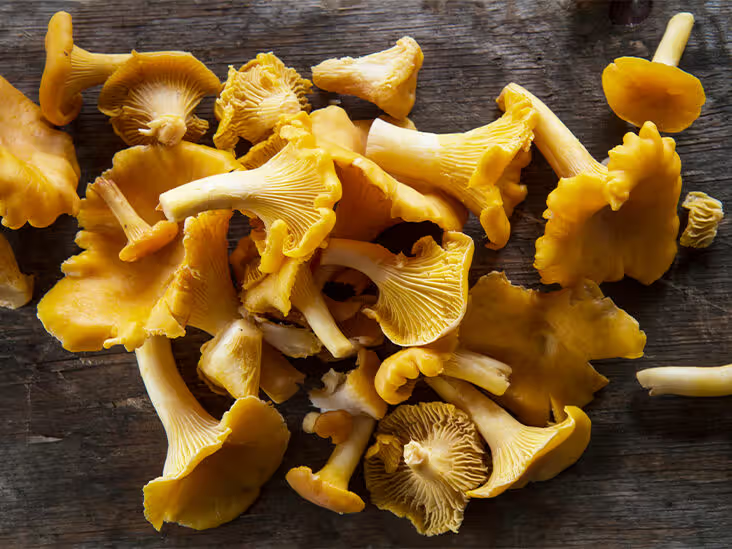
Is the main visual difference just the stem or whatever it’s called being much longer?
IIRC, the only definitive way to ID mushrooms is by making a spore print - and even then you need to know what you’re doing.
Just doesn’t seem worth the risk to me.
nah it’s generally fairly easy to ID mushrooms, the problem is just that if you miss a feature and mistake it for another, you’ll fucking liquidize from the inside out.
This is the same reason that you never touch something that looks like a carrot plant in the wild, because it could be that one plant that kills you 3 times over.
I agree that it’s generally not worth the risk though, hence why those who pick mushrooms (which is pretty standard to do here in the nordics) stick to like 5 species who have no dangerous lookalikes and actually taste good and are easy to find.
Here in sweden 90% of what people pick is chanterelles or boletes, whose entire families look effectively the same and at worst simply don’t taste good. Boletes have ONE slightly toxic species in sweden, and it’s bright red and only grows on one island in the baltic sea.
This is untrue. Spore print can be useful for some very similar species or when you are first learning but I’ve been picking and eating wild mushrooms for about 15 years now and I basically never do a spore print anymore. Once you learn it’s pretty unnecessary. The ones I pick are easy to ID anyway. Most people can learn to identify them fairly quickly with some instruction though I have noticed that some people lack the attention to detail to be good at it.
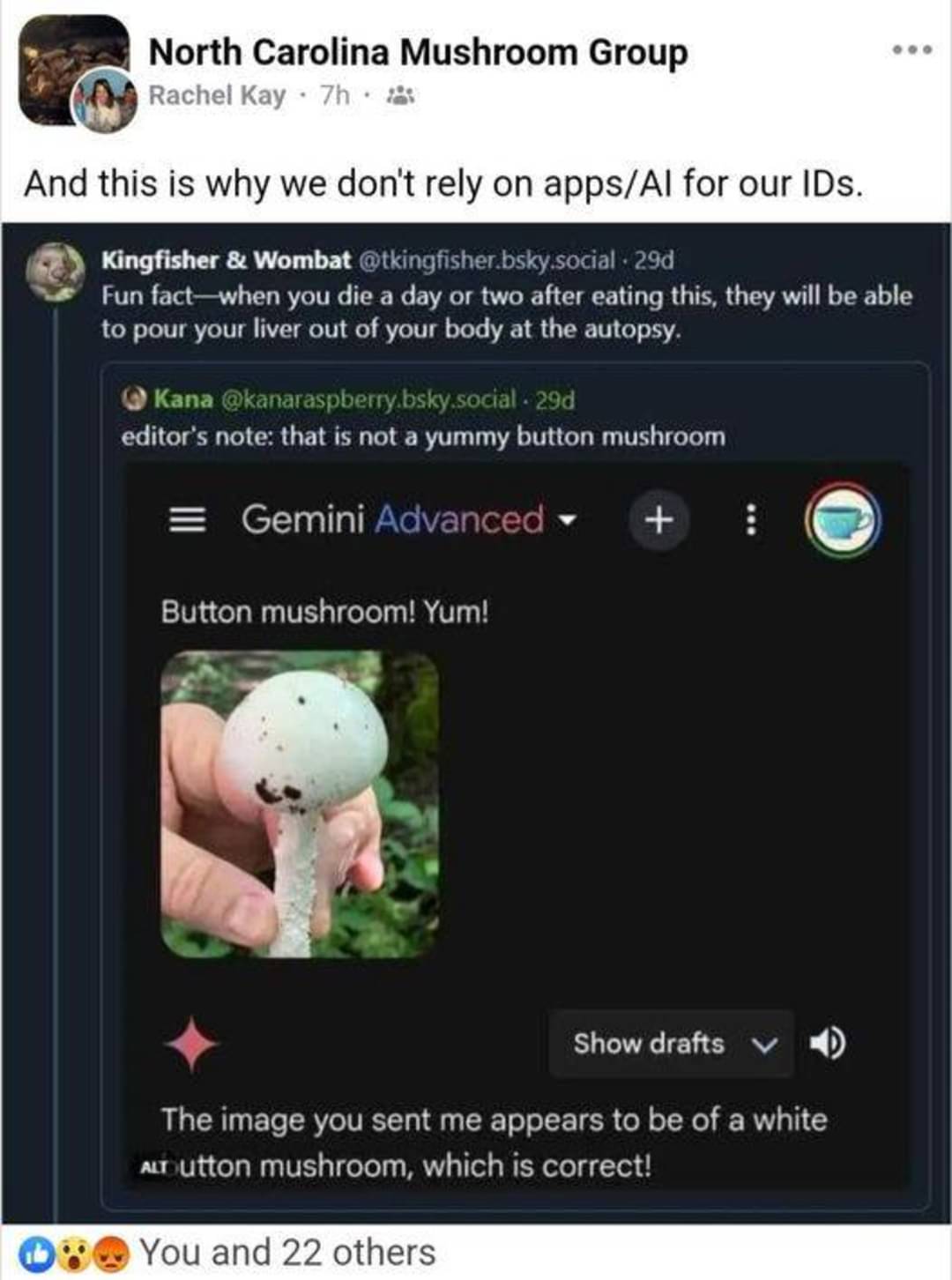
Lots of differences but the simplest one would be that button mushrooms would typically have color to their gills—depending on the species they usually start out pinkish or pale brown and move to dark brown as they get older. Destroying angel has pure white gills.
But button mushrooms are actually not very beginner friendly despite their familiarity since there are other poisonous lookalikes in many areas.
Neural networks are magical anywhere that near misses are good enough.
Companies keep using them as if they’re infallible, when lives and fortunes are at stake.
Tech is not the problem.
Looks like a destroying angel (e.g. Amanita virosa) to me. This and the death cap together account for the vast majority of mushroom poisonings in the world. Cooking it will not destroy the toxins, nor will acid. Symptoms tend to appear 5-24 hours after eating, too late to pump the stomach. Half a mushroom can be enough to kill you.
I don’t recommend going out to pick mushrooms unless you know what you’re doing. If you do, stay away from the white ones. You can still get terrible stomach cramps and diarrhea from other colors of mushrooms, but the white ones have the most dangerous species.
Amanita bisporigera, or the aptly named eastern North American destroying angel, if anyone’s wondering.
From Wikipedia:
The principal amatoxin, α-amanitin, is readily absorbed across the intestine, and 60% of the absorbed toxin is excreted into bile and undergoes enterohepatic circulation; the kidneys clear the remaining 40%. The toxin inhibits the enzyme RNA polymerase II, thereby interfering with DNA transcription, which suppresses RNA production and protein synthesis. This causes cellular necrosis, especially in cells which are initially exposed and have rapid rates of protein synthesis. This process results in severe acute liver dysfunction and, ultimately, liver failure.
I could not confirm that it causes liquefactive necrosis of the liver specifically, however. I wouldn’t doubt it, but I couldn’t confirm it.
Edit: I should clarify, I got this from the original thread on Bluesky, not my own identification.