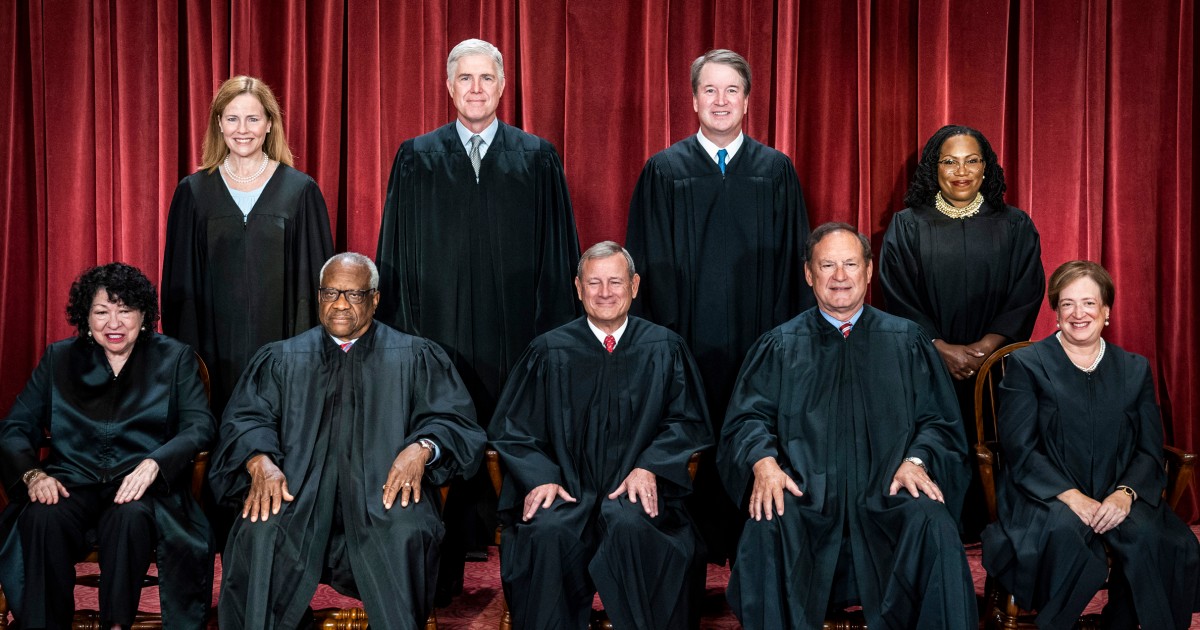
The vote was 212-206. All but one Democrat voted against it, as openness within the party to expand the high court by four seats grows.
The joint resolution, offered by Rep. Andy Biggs, R-Ariz., calls for amending the Constitution to say: “The Supreme Court of the United States shall be composed of nine justices consisting of one chief justice and eight associate justices.”
The office of House Minority Whip Katherine Clark, D-Mass., encouraged lawmakers to vote “no,” saying the amendment would take away a power intended for Congress and do nothing to address the “affordability crisis” under President Donald Trump.
“This proposed constitutional amendment would permanently fix the number of Supreme Court justices at nine, stripping Congress of yet another constitutional authority that is meant to be controlled by the American people’s representatives,” Clark’s office wrote to lawmakers Wednesday ahead of the vote
Term limits. Expand the court.
There were originally nine justices, one for each of the nine court circuits. There are now 13 (ish?) circuits. Increasing the number of justices isn’t some radical idea that came from nowhere, it merely aligns us with the original convention.
To add to this, each circuit requires an SC justice to be its “circuit justice”. Any “emergency” applications coming out of a circuit are addressed to the circuit justice individually, who can then make fast decisions as necessary. Any five votes on the court can then overrule anything a circuit justice does.
Anyhow, right now some justices have to do double duty on more than one circuit. So there is some kind of real impact to their workload that we could fix with 13 justices.
Term limits require an amendment, which is impossible in the current national climate. Expanding the court is just passing a law. So, win both chambers, eliminate the filibuster and expand the court to 15 seats. Maybe increase the House to over 1,000 members while you’re at it — effectively destroying any issues with the Electoral college and somewhat with gerrymandering.
Expand the court and remove the Permanent Apportionment act of 1929 that makes the House a defacto second Senate and disenfranchises a majority of the country. That artificially low limit of 435 across 300+ million people (based on nothing but the fact that’s how many House members there were at the time) is what makes gerrymandering so effective.
The House should have roughly 1500 members to have effective representation. That’s one representative per roughly 200k people. At the moment we’re at 670k average per representative, and that’s not at all consistent across the country.
The democrats tried this during FDR. Just put the fucking term limits in already.
Definitely. But also, it was never meant to stay at such a low number.
I’m am shocked that the Democrats would have the spine to do even this.
To be honest, such a move is symbolic anyway. Because there’s no way a constitutional amendment about anything is passing.
It’s also a symbolic move for 2 Democrats to vote with the Republicans - even more so because it clearly announces to the world, “We’re with the pedophile party.”
Changing the size of the court doesn’t require an amendment. Congress can do it whenever they want.
The only reason it is currently 9 is because the last law changing the size was the Judiciary Act of 1869. The maximum size it has been was 10 shortly before that.
Likewise the Constitution does not explicitly say that they have lifetime tenures. Article 3, Section 1 of the Constitution only says that justices “shall hold their offices during good behavior”. That had been generally accepted to mean a lifetime tenure, and only removed by impeachment, but it is not an explicit limit. One interpretation of that only refers to illegal activity immediately disqualifying them from holding that office, unrelated to any sort of term limit.