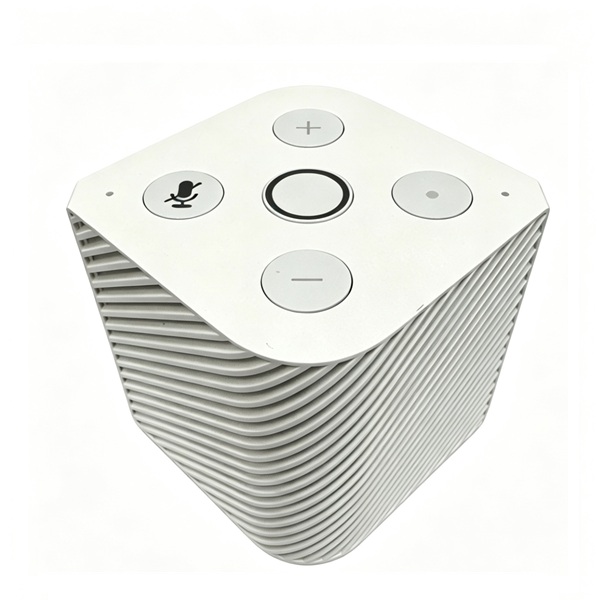
I just set two of these up. I’m not a HA guy so my HA server only has these assistants, my Sonos system, and Music Assistant set up.
I’m still fussing through setting up tasks, but it’s slowly turning into
AlexaJarvis.I have it set up to play, pause/stop music from music assistant with a really hacky yaml script.
It can tell me the weather forecast.
That’s all local processing with Whispr(stt) and Piper (tts).
For those who want the “tell me the tallest mountain in the world” type of support, the answer is cloud llms. I tried ollama on my PC, but it’s just too slow. I have an opencode go subscription and that works pretty well with deepseek-v4-flash. You can also use a standard open ai api key with one of the nano or micro models.
It works, not quite as good as Alexa, but it’s not bad.
Is this voice assistant something I can install on Android? I didn’t realize there was any alternative to Google or Siri (or Bixby).
Mycroft (afaik now called “ovos”), and the home assistant internal one come to mind
I believe you can! You don’t need this product though. See https://www.home-assistant.io/voice_control/android/
If you use Home Assistant you can configure the voice assistant to be the default one for android yes. Mine only does control and statuses for my local devices, can’t ask questions or anything but that’s probably configurable.
Only 30 days warranty?? They must not have a lot of faith in their product. That’s not even legal in a lot of countries (at least the EU, Australia, New Zealand, and some Asian countries).
US consumer rights standard, I believe. Some freedom they have over there. Should be US only warranty, as it is illegal for all of the rest of the western world at the minimum. Norwegian law is minimum 3 years - 5 if it’s expected to last for a long time. Less than a month is a liability parody.
(Re)pebble smartwatches also have only 30 days long warranties… https://repebble.com/warranty
Here’s a quote from one of their blog posts: https://repebble.com/blog/pebble-time-2-is-in-mass-production
We offer a 30-day warranty. We will ship you a replacement during that period if you encounter any hardware defects and return it . We think this is a fantastic watch, and we stand behind it. But we can’t stand up behind it forever - life happens. We’re also a much smaller company than before. We can’t afford to bring these new watches to market unless we can contain our exposure to risk. To balance that, we’re clearly stating our terms in the interest of being as transparent as possible, enabling you to make an informed decision.
We don’t offer buyer’s remorse refunds. The information about what Pebble is and does has been around for 14 years now. You all should have a pretty good idea of what the product is and whether you want it. It’s also very hard to do reverse logistics worldwide (ie getting watches returned). If you don’t want a Pebble, please don’t order one 😉.
I find that disappointing and I’m honestly confused about how that checks out legally in EU.
E: I like how AirGradient approached this where you get parts for DIY kit (which is practically almost fully assembled and it’s just formality to do the finishing screws) where you get no warranty but at a much cheaper price in return and the risk is on you: https://www.airgradient.com/indoor/
The monitor with warranty is 230 USD and the kit without warranty is 138 USD.
I think it may be a question of how involved the EU really is, are they even technically ‘selling’ an item in the EU? Yeah, obviously, people are buying and having it shipped to the EU, but if a product ships straight from a factory in China designed by a business in the US with no real presence in the EU, I’d imagine there’s likely just not a lot they could do to hold them to EU law.
Feels like the worst they could do would be to just not let them ship their product into the country anymore.
I’m pretty sure you just get a 30 day return period in the EU, regardless of your reason.
While I don’t fully agree with this (online shopping should not be encouraged, especially multiple round-trips for some clothes that you ordered in the wrong size), it is the law.
We don’t offer buyer’s remorse refunds
they most certainly do, or will when you threaten to report them.
When shopping online, you have 14 days after receiving without having to specify any reason. In store it depends on if the customer had the chance to look at the product. If yes, there’s no requirement to accept intact and functional goods.
In both cases you have 1 year where the manufacturer has to prove that the product was intact when you received it (e.g. it’s not a design/production defect).
The customer then can choose if they want to have the product replaced, repaired, or returned. (Within limits, if the price of repairs are uneconomical or the product no longer exists, the seller can refuse)
At least in Germany you then have 1 year where the customer has to prove that the defect existed at the time of sale, and there hasn’t been any “irregular or improper” use, for the seller to be forced to either repair, replace, or return the product.
Pine64 does not sell consumer products. These are for development and testing.
They sell directly B2C, which is the deciding factor.
The 30 day warranty seems to be default for them, all their products are only given 30 day warranty. Super shitty and like you mention illegal many places.
@ExcessShiv
In europe there is a big difference between the manufacturers waranty that is up to the manufacturer to offer or not to offer as he likes and the legal waranty that is an obligation for the seller that he cannot escape.
So in europe the customer always holds the reseller responsible and not the manufacturer.When the manufacturer is the seller, they’re still bound to the legal minimum requirements of warranty though.
Basically all their products are essentially dev kits. They are not meant for normal consumers. At least thwts how it has been for the phone, laptop, watch, etc.
The PineTime works great as a regular device as well! I did do a little dev’ing to get the weather to show in a watchface that hadn’t been updated to include it yet, but other than that it’s a solid device imo.
Which I guess is a nice way to avoid legislation…
Sure, but they wouldnt exist without that. Making micro batches of specialized hardware is not profitable at all. Offering a real warranty would immediately bankrupt them. If they sold more than a few thousand devices per model then i would care, but meanwhile big manufacturers get away with so much worse.
The Third Reality speaker also recently came out.
So now there are three. The Pine one, the Home Assistant one, and the third Reality one.
I’m looking at Third Reality’s website and I don’t see a speaker anywhere… Did they announce it somewhere?
Very cool!
The voice sattelites like this and the Home Assistant voice from a year back are great and I love seeing more options for self hosted fully local devices like this.
But honestly, what I find is missing for a fully local smart home setup is a “brain” for running the assistant LLM in a simple way.
There is plenty of cloud solutions for connecting AI, but true local hosting requires a rig with a proper GPU if you want timely responses. I wonder if it is possible to build a purpose built “brain box” for Home Assistant that is small, not too expensive, fully local.
It just sucks needing a rig with a RTX 3090 or whatever to get the full chain to run fully local. Small LLMs are stupid as dirt and our Home Assistant Green is in no way equipped to handle any form of LLM. I managed to get my gaming rig to host an LLM that was good enough, but I don’t want my gaming rig to be always on, and if I start gaming on it, the GPU has to deallocate all LLM business.
I love fully local stuff, but the LLM part seems very expensive. Even for such a simple thing as managing our lights and music.
I love fully local stuff, but the LLM part seems very expensive. Even for such a simple thing as managing our lights and music.
Yeah, this is something I found out when I hacked my Amazon Echo and put LineageOS on it. I like the new interface that isn’t constantly advertising Amazon bullshit as a screensaver, but it doesn’t have a GPU, so attempting to put any sort of voice component takes many seconds to try to process.
And in this post-memory-crisis economy, it’s not quite the right time to buy a dedicated LLM processing rig for my house. But, this really needs to be the route in the future. Or just install a NPU on this speaker itself. Phones already do this, and it’s been the standard since 2017.
Deleted by author
Get a Strix Halo box to be your headless AI server
They’re around 4k USD these days though…
At this price point, there are also DHX Spark on the Nvidia side… I don’t know how they compare, though. Our software tech lead got one at work to test if it can reduce cloud expenses!
I tried to get a Asus GX10 (DGX Spark from Asus), first unit was boot looping, replacement got through OOBE then failed to mount the drive and kernel panicked.
I got my money back.
I’m just gonna shamelessly plug my project here: https://github.com/charludo/hass-closest-intent
You do need local STT, but it’s fine if it’s somewhat bad; the conversation agent linked is sufficient to “get” what you meant, without LLM.
I really appreciate the clarity and straightforward intro in the readme.
Looks really interesting. I will definitely Check it out
I love fully local stuff, but the LLM part seems very expensive. Even for such a simple thing as managing our lights and music.
So, the simple things should just be voice command (not recognition, limited vocabulary), <wakeword> kitchen light on, what’s todays weather (assuming you automatically download it and have it there, needs TTS like whisper). That can run on a recent potato. Somewhat more complex things need full voice recognition e.g. Play me x songname by y artist. Laptop CPU should handle that fine. You’ll only need a full LLM for more general inquiries, e.g.<wakeword> What mess has Trump made today?, which will need web access seeing as small LLMs don’t have a lot of world knowledge (although you can self host Wikipedia and point it at that).
If you have a desktop computer and a GPU with 16+GB VRAM (or even smaller using RAM and a MoE LLM) that’ll do the job with reasonable smarts e.g. Qwen 3.6 35BA3B, Gemma 4 12B or 26BA4B. You may have to wait a minute or two. Mine pulls around 55W at idle (7800XT) and does double duty as a NAS and gaming rig, or you can have it sleep most of the time and let the laptop wake it up when necessary.
<wake word> “how much is using local LLMs for trivial things raising world wide energy usage and causing a RAM shortage?”
I actually have things like “play x by y” functioning really well without a LLM.
Have a custom service that exports all song/album/artist names from MusicAssistant, does some simple cleanup, and places the list where HomeAssistant expects it for custom voice intents. Then this: https://github.com/charludo/hass-closest-intent is enough that imperfect STT can still easily be matched to those song/artist/… names.
Sweet.
If it keeps playback functionality only on LAN then it could be a good replacement for the Google Home units I have stashed around that constantly need to ping home even for basic local playback.
If you’re talking about Google Home Mini or Google Nest Mini, there is a project on GitHub which replaces the PCB with an open alternative. The boards for the Home Mini are in production right now and Nest Mini is going to be the next.
Ooh, outstanding - I searched recently for whether it was possible to flash open firmware and that seemed to be a bust, but I never thought about a board replacement!
Thanks for the link, I’ll be looking into this with great interest.
Edit: ah damn, just saw the price plus shipping to me, and it’s a fair bit more than buying complete package other options. It’s definitely an awesome initiative and this guy has done an admirable job, just might not be the best fit for me right now. I don’t want to contribute to hardware waste, so will keep running what I’ve got instead of buying brand new speakers, but will keep an eye on this project for sure.
Does yours even work? I have a Polk Google nest capable sound bar and like 4 of the small nest mini speakers and the groups have always inconsistently worked and overall it works like utter shit.
Yeah I’ve got two sitting around and they work pretty well, but I’m annoyed that they need WAN access to stay working for playing my local media. Would prefer a WAN blackout at the router level to make sure that the microphone off toggle doesn’t get “accidentally circumvented” by Google.
My thoughts exactly. Is it a hardware switch, or a hardware switch that just sends a signal to a software switch… 🤔