

I am sorry if my english is bad.
You must log in or register to comment.
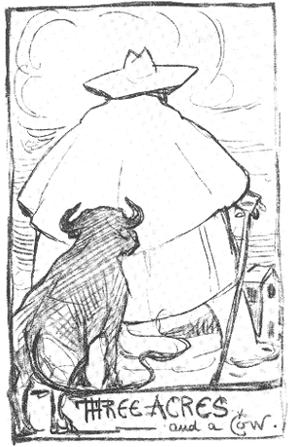
Not only is there no plan or plausible path to implementation, it just wouldn’t be possible even if we could snap it into existence. How do scattered producers create and maintain complex industries like semiconductors and global supply chains? They don’t. So we’re already past the petite bourgeois “three acres and a cow” option, because we cant turn the clock back on industrialization.
That leaves co ops as a form of distributivist property ownership, which is about the same as RD Wolff style Co op socialism. This has a host of problems like maintaining basically every element of capitalism besides ownership without labor, like anarchic competition, destruction of unsellable goods, alienation from labor, commodity fetishism, etc. It ignores the class character of the state as if the current owners of property would ever allow this to happen. Even if it did, it would result in capital accumulating in the hands of a few powerful co ops the way it does now, just with a few more owners who also work. But they could still monopolize a market like a corp and would have to be manually broken up by a state. But since they would be the most powerful actors in society, the state would be used to maintain their interests. They would seek to cement their power and pass laws like inheritance and private property and normal capitalism would resume after a short time.
Utopian nonesense, ideal worldbuilding with zero materialist analysis.
Exactly. No plan to make it happen and no way to keep things that way.
I need to read the theoretical base of distribution to understand it in more detail, since the Wikipedia article is extremely superficial.
The problem of distributism is that, like many utopian socialist ideas, they look at what they see as the ideal society and just preach about going to this utopia. It comes from a moral critique of capitalism, and some kind of reactionary thinking because it sees a glorified distant past as a proof of how things were good then, but now they are bad.
We Marxists usually see cooperatives with good eyes, but the problem of having this moral view on small and medium-sized proprietors in a distant past is that it fails to see how capitalism came to be, and the historical developments that led to what capitalism became in the 19th century. One central analysis of Marx is the connection between economic and political power. It would be impossible to maintain this balance of small and medium private enterprises, while sustaining this balance with a juridical superstructure as the mechanisms of capital accumulation and competition would then reproduce capitalist society with enough political power to influence this juridical superstructure. It’s not a coincidence that this model of super accumulation became the norm in capitalism everywhere. Even in socialist China, there’s a contradiction between the billionaire’s interests and the communist party and this contradiction leads to arrests, corruption charges, and imprisonments.
The theory of distributism also does not state how the transition between a capitalist society and their ideal model will take place. There’s no talk about the construction of political organizations and if there’s any they tend to just operate under the umbrella of bourgeois politics. So there’s no concrete break with the capitalist political system or a transition proposed whatsoever.
So in summary, distributism does not offer anything far from capitalism and no politics to fight against it. I would compare it to libertarianism, just a set of seemly radical but incoherent ideas when tested against reality and history which ends up just reinforcing capitalist ideology.
Hi. Sorry I have to hurry, but this statement here is really telling:
Distributism views laissez-faire capitalism and state socialism as equally flawed and exploitative, due to their extreme concentration of ownership.
Thanks for the reply, my communist friend.
Sorry I have to hurry, …
No need to rush to answer my question. I have plenty of time.
So this just sounds like liberalism. Although it is not exactly like now, it is a lot like the crafts gilds that Freemasonry gave us, and the mythos that eventually birthed the United States revolution.
Now I’m not saying Freemasonry and gilds are all bad, but you will find a lot longer list of well-known members who were liberal and fascist than were socialist, in any form (my heart was rent, when I learned Yeats was a fascist).


