I understand feelings around struggle and how they get directed. Ive looked at broader statistics around immigration and economics, but not specifically around tax receipt vs contribution over time, so I’m genuinely curious about the statistics on immigrants becoming net tax recipients.
I am perhaps making a jump but I think it would be easy to say that this is not just a Somali issue. I don’t think Somalis are extra exploitative or something, I think they’re smart people from a poor country where you do whatever you can to survive.
And a lot of nations are like that, and I would imagine that many of them have found the same loopholes in our state and federal government.
Yikes, those outcomes are rough and not an easy problem to address. But we were talking about immigrants in general, not a particular subgroup of immigrants. I could carve out a sub-population of US-born people, like fentanyl addicts and show they’re a net drain on tax-payers too. Or entire states like West Virginia or Alabama for that matter.
I wasn’t suggesting that nobody else does this at all. I’m saying that the proportion matters, the statistics both in subpopulations and overall tell the complete story. What you’re suggesting is like saying a state like Alaska or California alone is representative of the entire country.
My initial post said people were tired of seeing immigrants using and exploiting government welfare; not that the vast majority of them are exploiting.
My argument wasn’t against the implication about the “vast majority exploiting”, not even the article you posted suggested the vast majority of Somali immigrants were “exploiting”. I was arguing against the suggestion that the problem of “a large proportion of Somali immigrants in Minnesota live in/near poverty and remain so over 10 years resulting in a net draw on tax funding” is generalizable to immigrant populations across the country.
Why would you say people (presumably you mean in general) be tired of seeing it if you weren’t suggesting it was also a pervasive problem? If the situation of the Somali immigrants was statistically uncommon across the country, then the explanation of “people are tired of seeing it” would be a poor one.

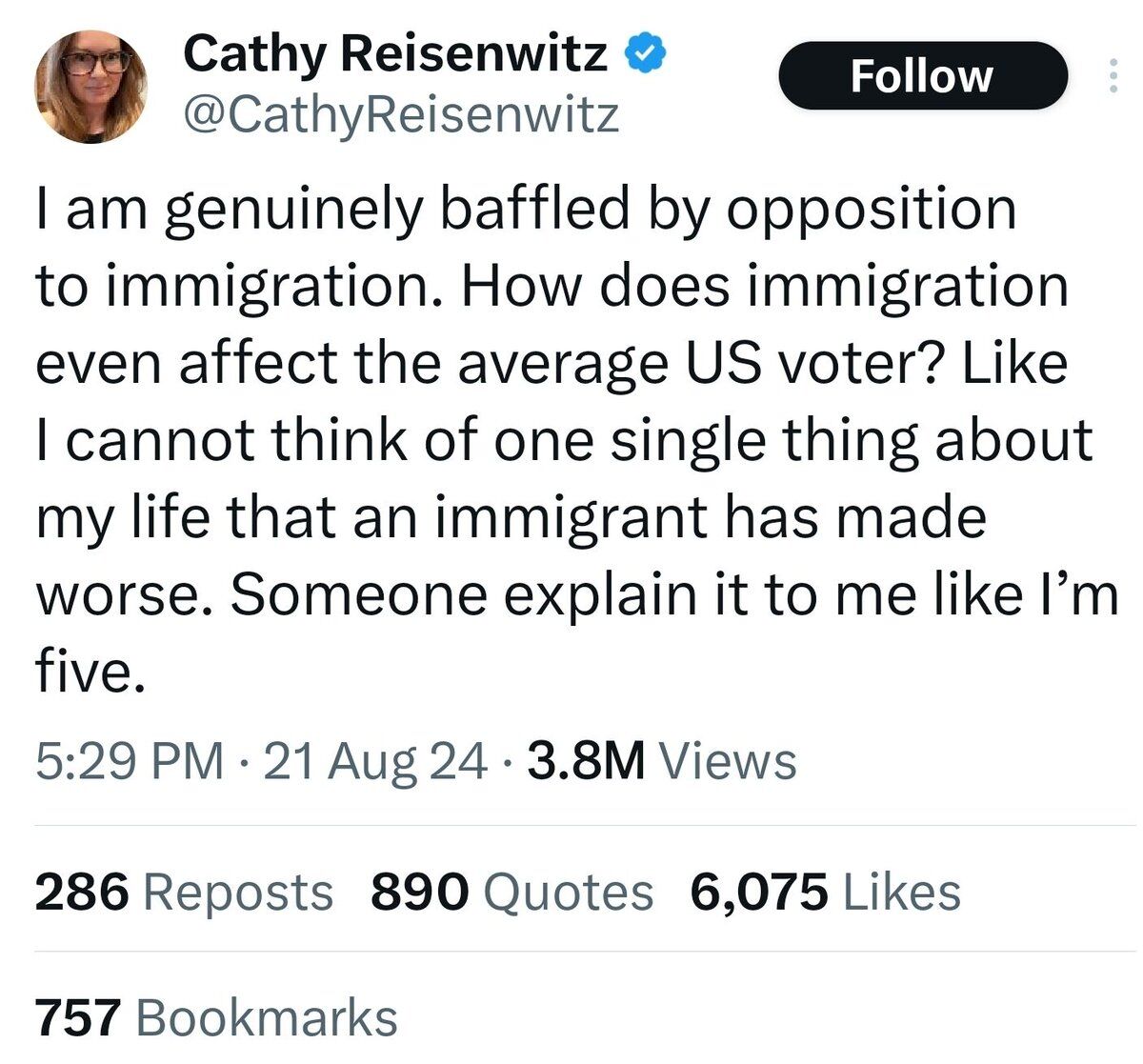
I understand feelings around struggle and how they get directed. Ive looked at broader statistics around immigration and economics, but not specifically around tax receipt vs contribution over time, so I’m genuinely curious about the statistics on immigrants becoming net tax recipients.
https://cis.org/Report/Somali-Immigrants-Minnesota
I am perhaps making a jump but I think it would be easy to say that this is not just a Somali issue. I don’t think Somalis are extra exploitative or something, I think they’re smart people from a poor country where you do whatever you can to survive.
And a lot of nations are like that, and I would imagine that many of them have found the same loopholes in our state and federal government.
Yikes, those outcomes are rough and not an easy problem to address. But we were talking about immigrants in general, not a particular subgroup of immigrants. I could carve out a sub-population of US-born people, like fentanyl addicts and show they’re a net drain on tax-payers too. Or entire states like West Virginia or Alabama for that matter.
There’s no reason to believe that only Somalis do this, only somalis have been caught.
The idea that only one culture of immigrants does this doesn’t fly in my book.
I wasn’t suggesting that nobody else does this at all. I’m saying that the proportion matters, the statistics both in subpopulations and overall tell the complete story. What you’re suggesting is like saying a state like Alaska or California alone is representative of the entire country.
My initial post said people were tired of seeing immigrants using and exploiting government welfare; not that the vast majority of them are exploiting.
My argument wasn’t against the implication about the “vast majority exploiting”, not even the article you posted suggested the vast majority of Somali immigrants were “exploiting”. I was arguing against the suggestion that the problem of “a large proportion of Somali immigrants in Minnesota live in/near poverty and remain so over 10 years resulting in a net draw on tax funding” is generalizable to immigrant populations across the country.
Why would you say people (presumably you mean in general) be tired of seeing it if you weren’t suggesting it was also a pervasive problem? If the situation of the Somali immigrants was statistically uncommon across the country, then the explanation of “people are tired of seeing it” would be a poor one.